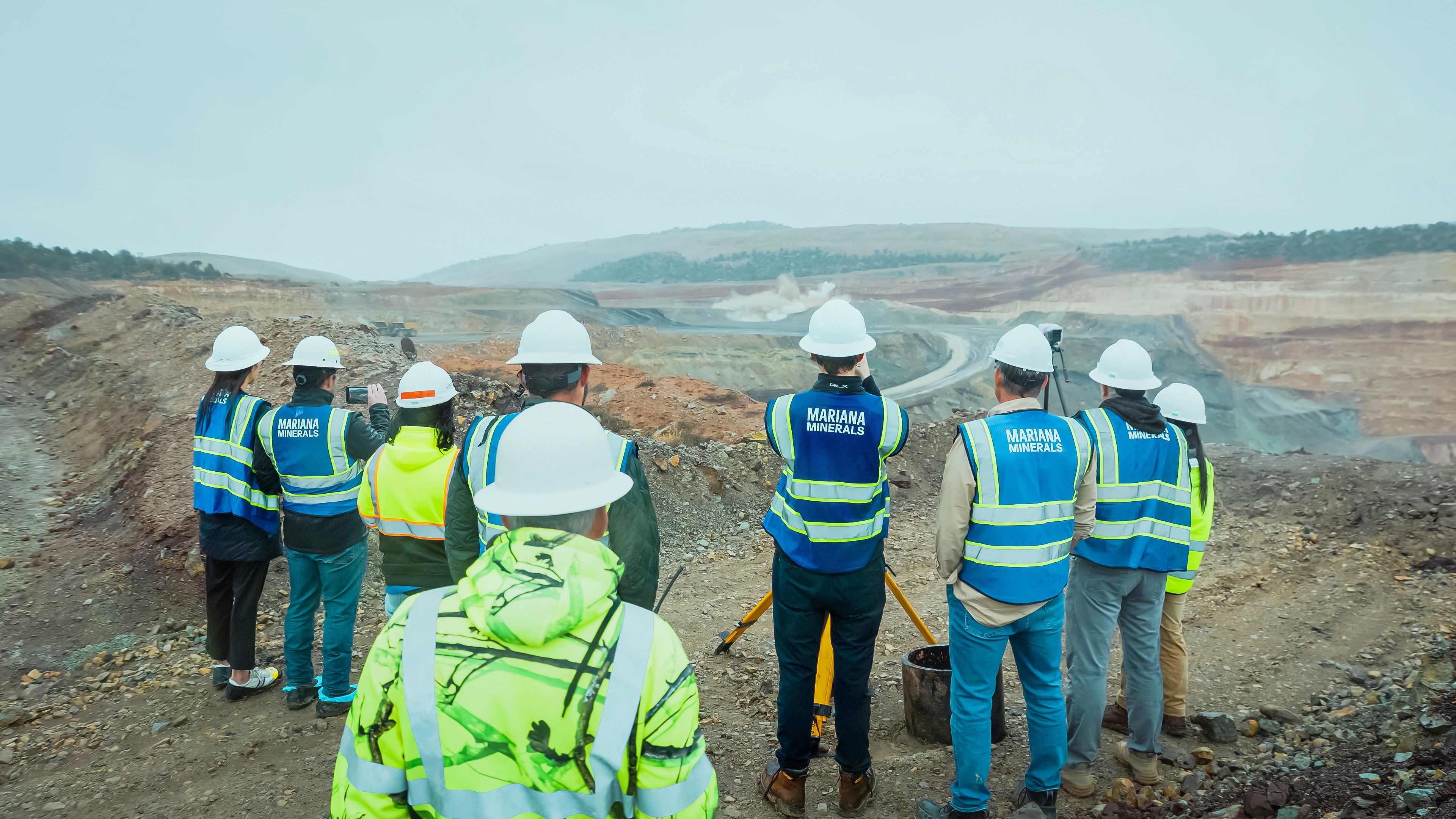
Mariana Minerals is a vertically integrated, software-first mining company developing lithium, copper, and nickel projects in the US. Our goal is to build 10 projects in 10 years in these and other metals — fundamentally breaking the pace at which this industry moves.
Why does that matter? The world needs to build more than 500 new mines and refineries in the next decade to supply the critical minerals that make AI infrastructure, defense systems, EVs, and everything else in our modern economy. Just to transition to renewable energy in the next 25 years, we need to produce more copper than in all of human history combined. And we're not ready. Western mining companies are getting slower, not faster. Productivity in mining and construction has been declining for two decades. 40% of the US mining workforce is retiring this decade. We graduate fewer than 400 mining engineering students a year. The tools that run most mine sites and capital projects are spreadsheets, whiteboards, and software that predates the iPhone.
Who we are
Mariana Minerals is not building software to sell to mining companies. We are a mining company that builds software to help us make more metal.
We design, build, commission, and operate our own mines and refineries. We develop our own chemical processes. We're producing battery-grade lithium salts from real oil and gas wastewater in our lab and pilot facilities today. Our first commercial-scale lithium production facility, Lithium One, is targeting production in the first half of 2027.
The software — what we call MarianaOS — exists to make our projects come online faster and run better. We don't sell it. We deploy it into our own operations and measure its impact in tons of metal produced, dollars of cost removed, and months shaved off construction timelines.
The work
Everything we build falls into one of three categories:
Design and build mineral projects faster. CapitalProjectOS is our integrated capital project execution platform. The problem it solves: getting a mine or refinery from concept to operation involves thousands of people across engineering, procurement, construction, and commissioning — and they're all working in silos, using disconnected tools, passing information through lossy handoffs. We're breaking those silos down. We're building the scaffolding and domain context to apply LLMs to real engineering workflows — not chatbot wrappers, actual engineering work. We're making it possible for smaller, more agile teams to deliver large-scale capital projects without the schedule and cost overruns that define this industry. The problem space spans micron-scale chemistry to kilometer-scale infrastructure.
Operate the most modern, digitally-forward mines and refineries. MineOS and PlantOS are our autonomy platforms. On the mining side: autonomous fleet deployment, integrated geologic models, real-time mine planning. On the refining side: dynamic process control, real-time quality monitoring, equipment health management. We're building the operating system for physical mineral operations — in a domain where meaningful software barely exists yet. Almost everything here is greenfield. We're not improving an existing product by 10%. We're building systems that didn't exist before.
Optimize and drive production. PlantOS includes our reinforcement learning platform. It dynamically adjusts operating conditions in our minerals processing facilities and refineries, adapting to input variability in ways that human-controlled facilities can't. Wastewater compositions shift. Ore grades change. Feed rates fluctuate. The RL system responds in real time. We're targeting a 50% compression in commissioning timelines and a 25%+ reduction in steady-state operating costs. Ship a feature here and you can watch the needle move — recovery rates, reagent consumption, energy intensity, equipment uptime. These aren't proxy metrics. They're the actual physics of making metal.
Prioritization
So how do we figure out what to work on? We work on whatever helps us make more metal, faster. That’s it. We look at our performance metrics and find the gaps. Where are we losing time in the construction schedule? Where does friction exist between engineering and procurement that's adding weeks to a timeline? Where is an operator making a suboptimal decision because they don't have the right data at the right moment? Where is there headroom to optimize a process that's already running but leaving recovery on the table?
This has a few implications worth spelling out. First, we need to actually understand the domain. Our PMs spend time on mine sites. They learn how flotation circuits work. They sit with construction managers and understand why procurement delays cascade into commissioning problems. The product intuition we build here comes from deep operational knowledge, not user interviews with buyers who may or may not represent the actual end user.
Second, we can move fast. We don't need to validate product-market fit because we are the market. If we identify a real problem and build a real solution, adoption is a conversation, not a sales cycle. The constraint is building the right thing, not convincing someone to buy it.
Third, the scope of what we can touch is enormous. Mining is the last major industrial sector that hasn't been rebuilt with modern software. The opportunity set isn't a feature gap on an existing product — its entire workflows and systems that don't exist yet. That's rare. Especially at this scale.
The people we're building for are chemical engineers, metallurgists, process engineers, geologists, construction managers — people who understand the physics of what they're doing and can tell you exactly where the bottlenecks are. That's unusual. In most software companies, there's a translation layer between the PM and the person who actually knows the domain. Here, the domain experts are our direct collaborators. They'll push back on our designs with real constraints. They'll tell us when our model is wrong and why.
The build
The tech is real and it's some of the most interesting applied AI work happening right now. PlantOS uses the same reinforcement learning toolkit powering self-driving vehicles and humanoid robots — except we're using it for autonomous, short-interval control of minerals refining circuits. We adjust operating set points and configurations in real time, optimizing across lithium recovery, reagent consumption, energy intensity, and equipment uptime simultaneously. The feedstock is variable and messy — wastewater compositions shift, ore grades change — and the system has to adapt continuously. The goal is fully autonomous refining operations with no human in the loop.
On the mining side, MineOS is integrating geologic block models, short and long-range mine plans, fleet management systems, and industrial control systems into a single optimization layer. We're accelerating autonomous fleet deployment and working toward global optimal operations across the full mine-to-mill chain. The full scope and complexity of this problem is exceptional. Our goal is to build an accurate digital twin of the site that incorporates the uncertainty inherent in the operations and then use it to determine how to maximize the lifetime value of the mine.
CapitalProjectOS is where a lot of the agentic work lives. We're building LLM-powered systems with deep domain context and scaffolding purpose-built for engineering, procurement, and construction workflows. Not generic copilots — agents that understand how a piping and instrumentation diagram relates to a procurement schedule, and how that relates to a construction sequence. The information flow across a capital project is massive and lossy. We're making it fast and lossless.
Every project we build generates operational data that makes the software smarter, which makes the next project faster and cheaper. That's the flywheel — and it's why being vertically integrated matters. We're not waiting for a customer to give us access to their data. We own the projects. We generate the data. We close the loop.