News
03.16.2026
Announcing Copper One:
The World's Only Autonomy-First Mine and Refinery
Announcing Copper One: The World's Only Autonomy-First Mine and Refinery
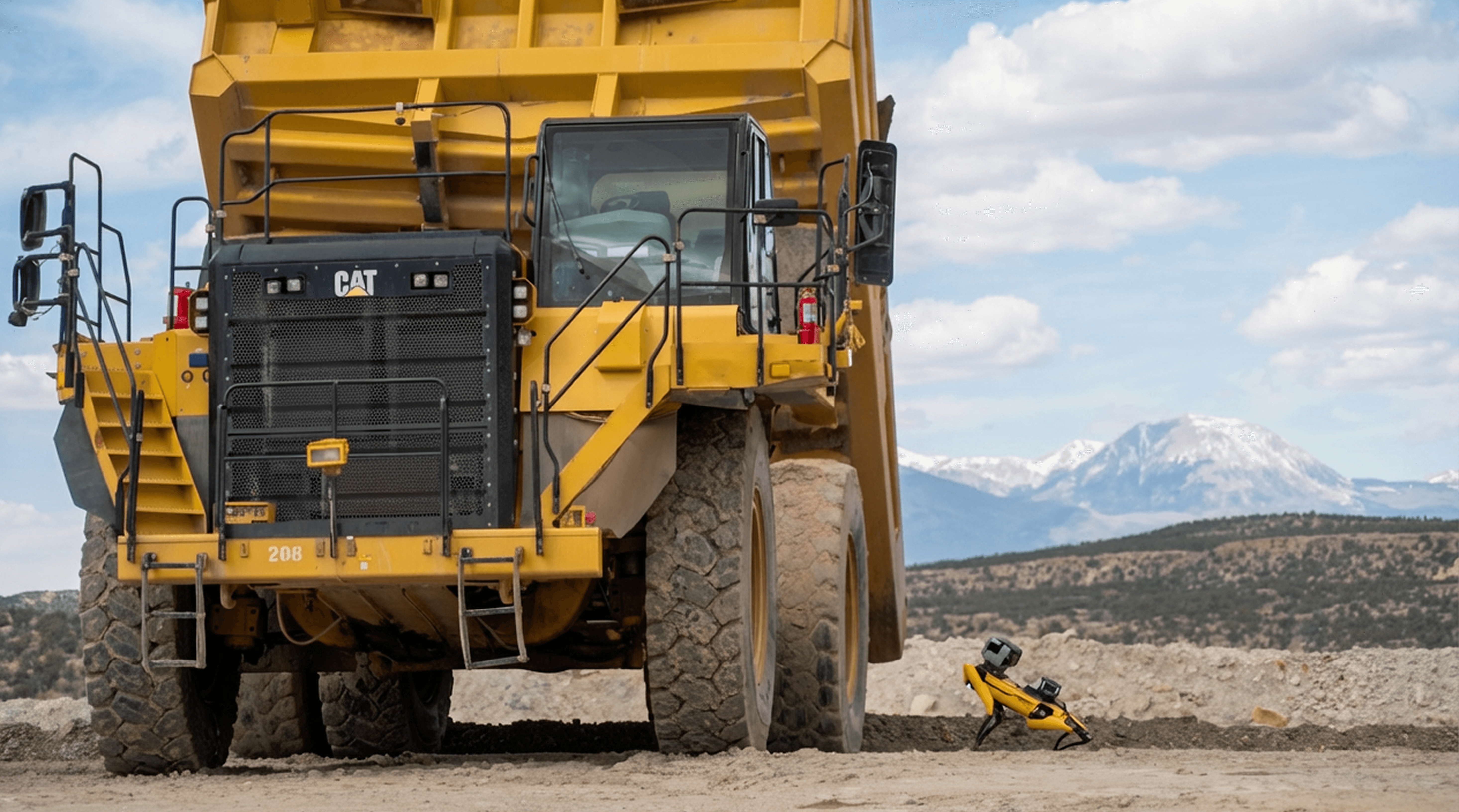
Located in southeastern Utah, Mariana Copper One is an operating copper mine and refinery currently producing high-purity copper cathode for the U.S. market. The site, which we acquired in late 2025, has been operating for over 15 years and includes an existing open pit mine, a heap bioleaching operation, a hydrometallurgical refining circuit utilizing solvent extraction and electrowinning, and significant expansion potential. Over the past 12 months, Mariana partnered with the existing site team - previously Lisbon Valley Mining Company - to develop and deploy advanced software and autonomous systems that will overcome past operational challenges and expand copper output.
Our path forward is clear:
Deploy PlantOS at scale to maximize copper recovery and reduce copper refining costs throughout heap leaching, solvent extraction, and electrowinning.
Restart mining operations with autonomous equipment and orchestration via MineOS.
Integrate copper scrap processing into the refining circuit, leveraging PlantOS to manage feedstock variability and to put a meaningful dent in US copper scrap exports.
Scale combined output at the site to 50,000 metric tonnes per year from both geologic and scrap feedstocks (leveraging CapitalProjectOS to accelerate capital project delivery).
This is Physical AI at scale.
Why copper?
Copper is the circulatory system of the modern economy. Nicknamed “Dr. Copper” for its ability to diagnose economic health, copper is central to power generation, supply and conversion, AI datacenter build-out, residential, commercial and industrial infrastructure, electric vehicles, grid-scale energy storage, and advanced defense systems. Anywhere electricity is generated or consumed, copper is at work.
Why copper?
Copper is the circulatory system of the modern economy. Nicknamed “Dr. Copper” for its ability to diagnose economic health, copper is central to power generation, supply and conversion, AI datacenter build-out, residential, commercial and industrial infrastructure, electric vehicles, grid-scale energy storage, and advanced defense systems. Anywhere electricity is generated or consumed, copper is at work.
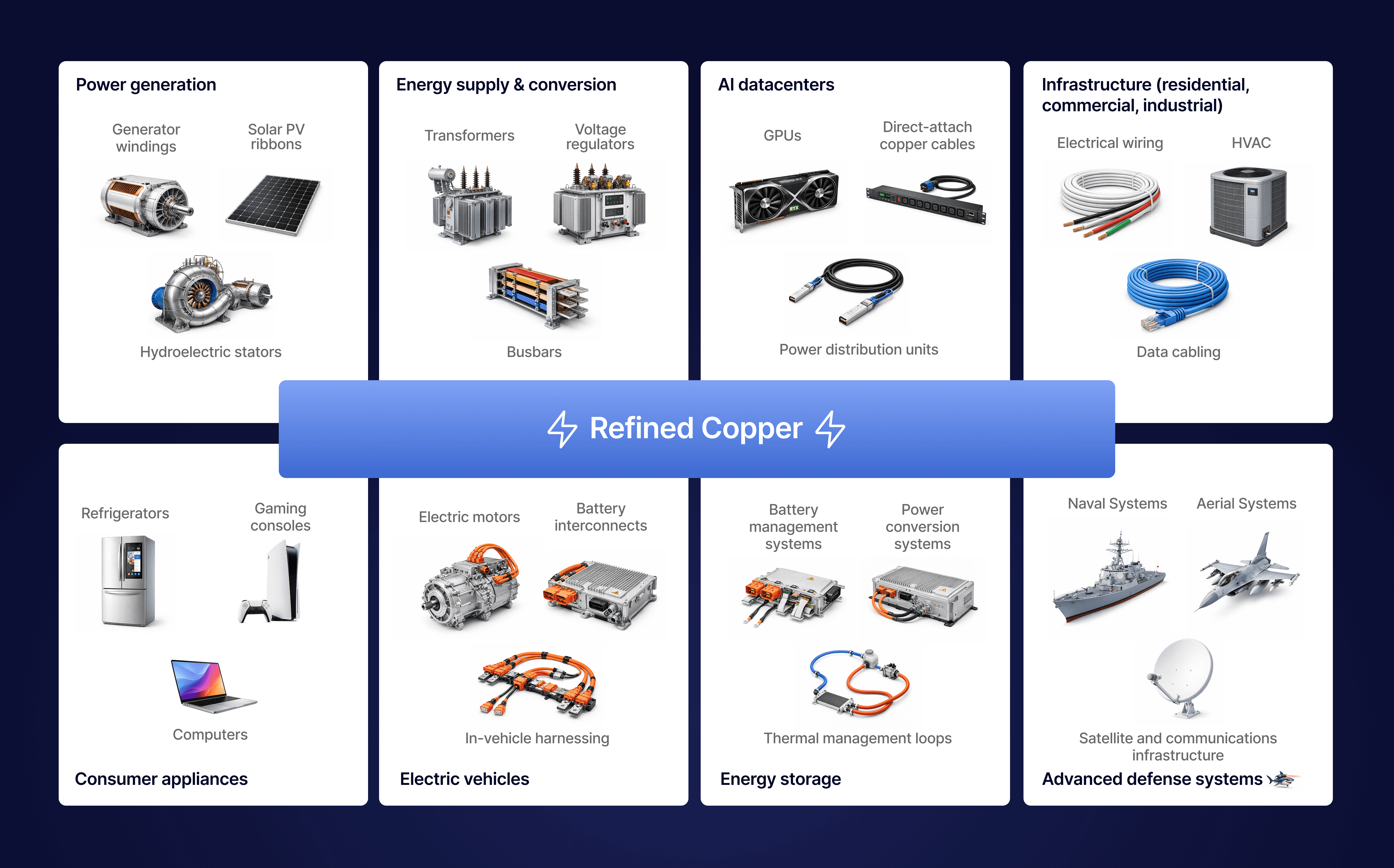
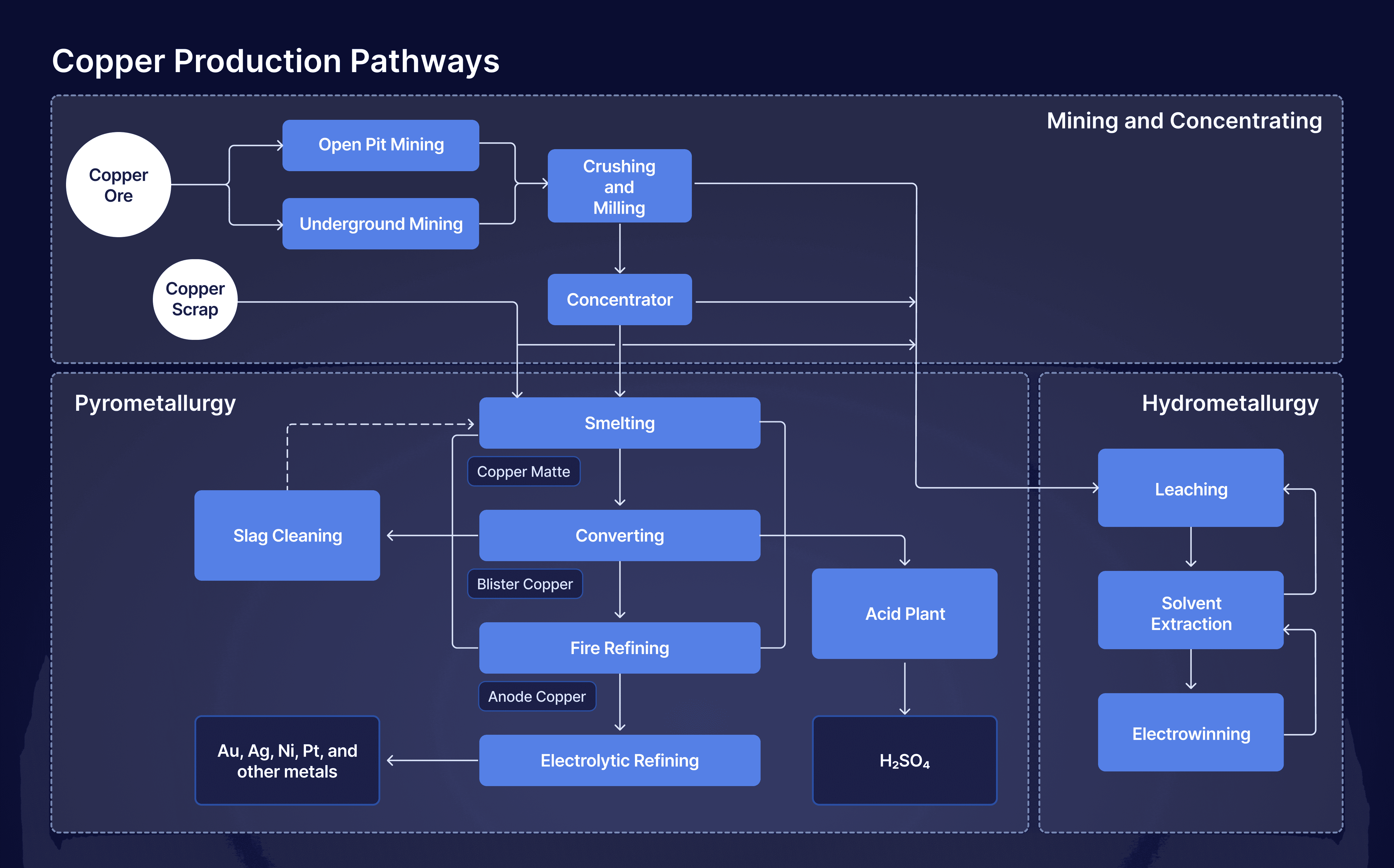
As our global energy, transport, infrastructure, and defense systems modernize, we need copper. A lot of it. By 2050, we must double global copper mining and refining capacity - this means mining and refining more copper in the next 25 years than in all human history combined.
How is copper produced today?
In thinking about how we will produce enough copper to meet accelerating demand, it’s important to first understand how copper is mined and refined today. We’ll start with the high-level and provide additional details around Mariana’s mining and refining pathway in subsequent posts.
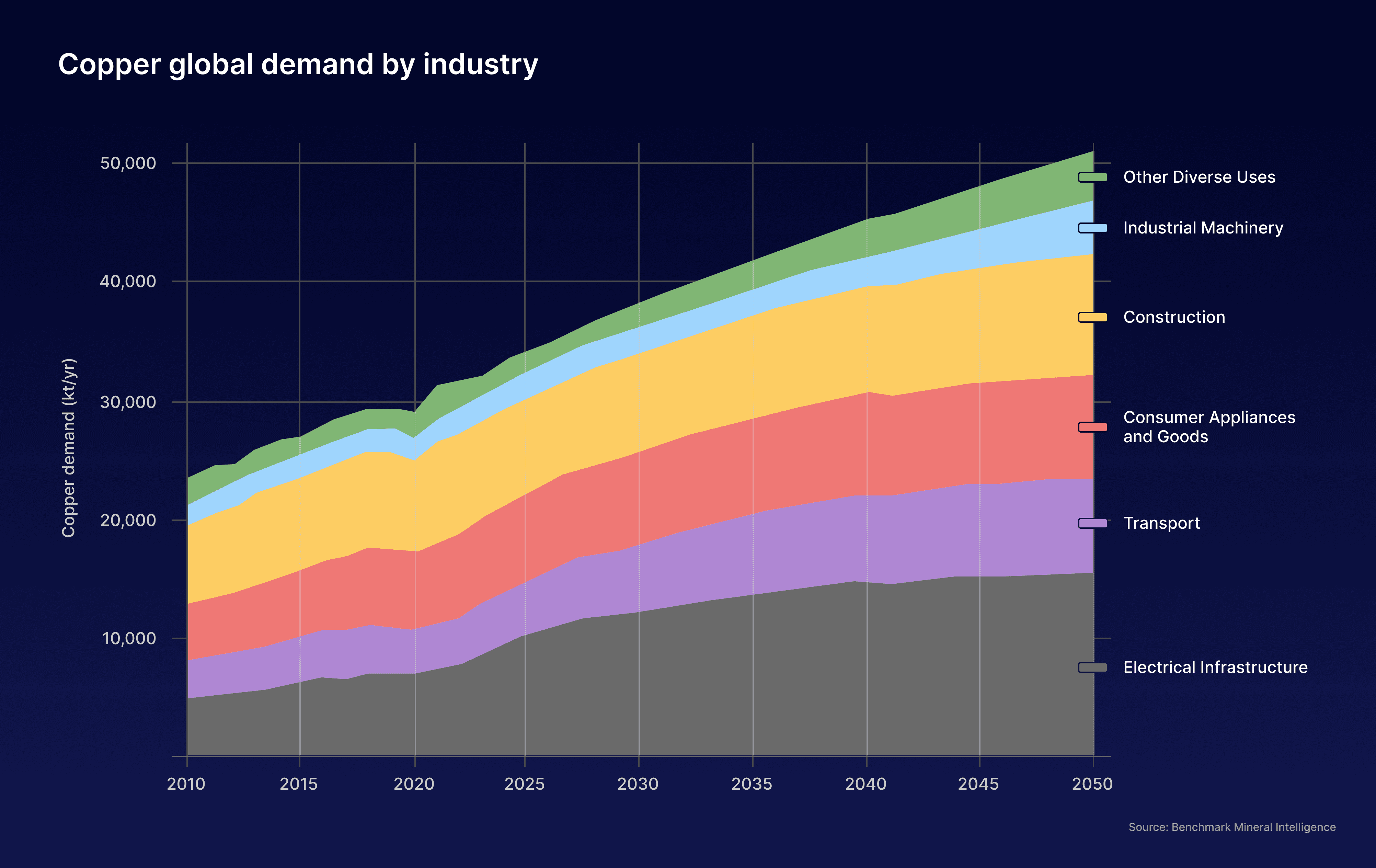
Primary copper supply (mined copper) typically comes from 2 types of ores: copper sulfides and copper oxides. These ores are mined via open pit or underground mining, then processed through 2 common pathways - pyrometallurgy (high-temperature smelting) and hydrometallurgy (chemical leaching and solvent extraction) - to produce high-purity copper cathode for downstream manufacturing.
Building a robust, sustainable copper business requires a deep understanding of both the mineralogy of various ore types and of the metallurgical processes involved in concentration and refining. These are inextricably linked: processing and refining pathways cannot be developed independently of the ores being processed. This is ultimately what leads to the bespoke nature of the mining industry: what works at one site with one type of rock does not work at another. This is a major driver of the complexity involved in expanding copper production capacity globally.
Where is copper produced today?
Copper production and trade are highly concentrated. A small group of mining countries - Chile, Peru, Indonesia, Australia and Brazil - account for the majority of global copper ore exports, reflecting the concentration of major deposits in the Andes and Asia-Pacific regions. On the demand side, China dominates as the world's largest importer, with Japan and South Korea also serving as major buyers.
Building a robust, sustainable copper business requires a deep understanding of both the mineralogy of various ore types and of the metallurgical processes involved in concentration and refining. These are inextricably linked - processing and refining pathways cannot be developed independently of the ores being processed. This is ultimately what leads to the bespoke nature of the mining industry: what works at one site with one type of rock does not work at another. This is a major driver of the complexity involved in expanding copper production capacity globally.
Where is copper produced today?
Copper production and trade are highly concentrated. A small group of mining countries - Chile, Peru, Indonesia, Australia and Brazil - account for the majority of global copper ore exports, reflecting the concentration of major deposits in the Andes and Asia-Pacific regions. On the demand side, China dominates as the world's largest importer, with Japan and South Korea also serving as major buyers.
How is copper produced today?
In thinking about how we will produce enough copper to meet accelerating demand, it’s important to first understand how copper is mined and refined today. We’ll start with the high-level and provide additional details around Mariana’s mining and refining pathway in subsequent posts.
Primary copper supply (mined copper) typically comes from 2 types of ores: copper sulfides and copper oxides. These ores are mined via open pit or underground mining, then processed through 2 common pathways - pyrometallurgy (high-temperature smelting) and hydrometallurgy (chemical leaching and solvent extraction) - to produce high-purity copper cathode for downstream manufacturing.
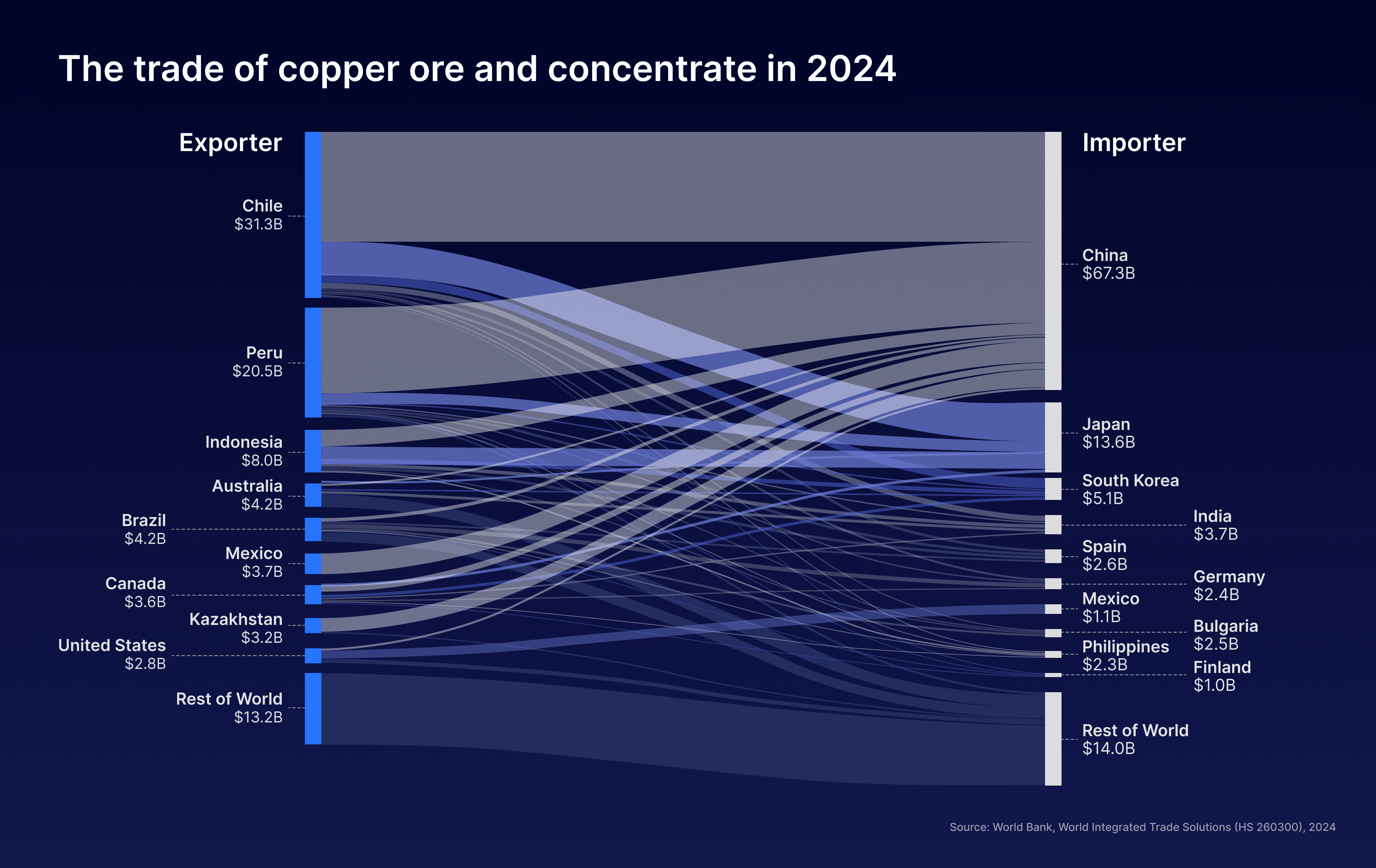
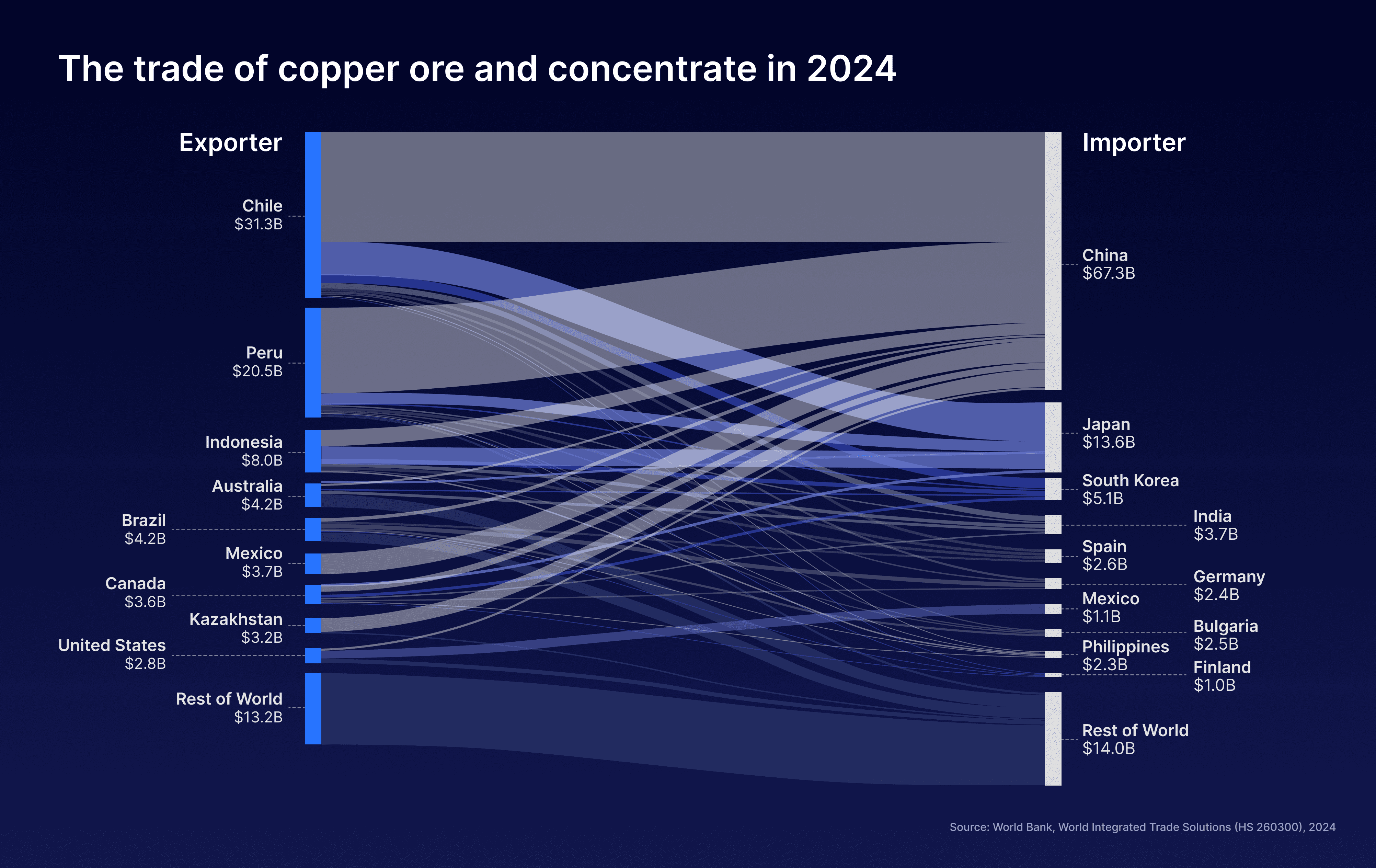
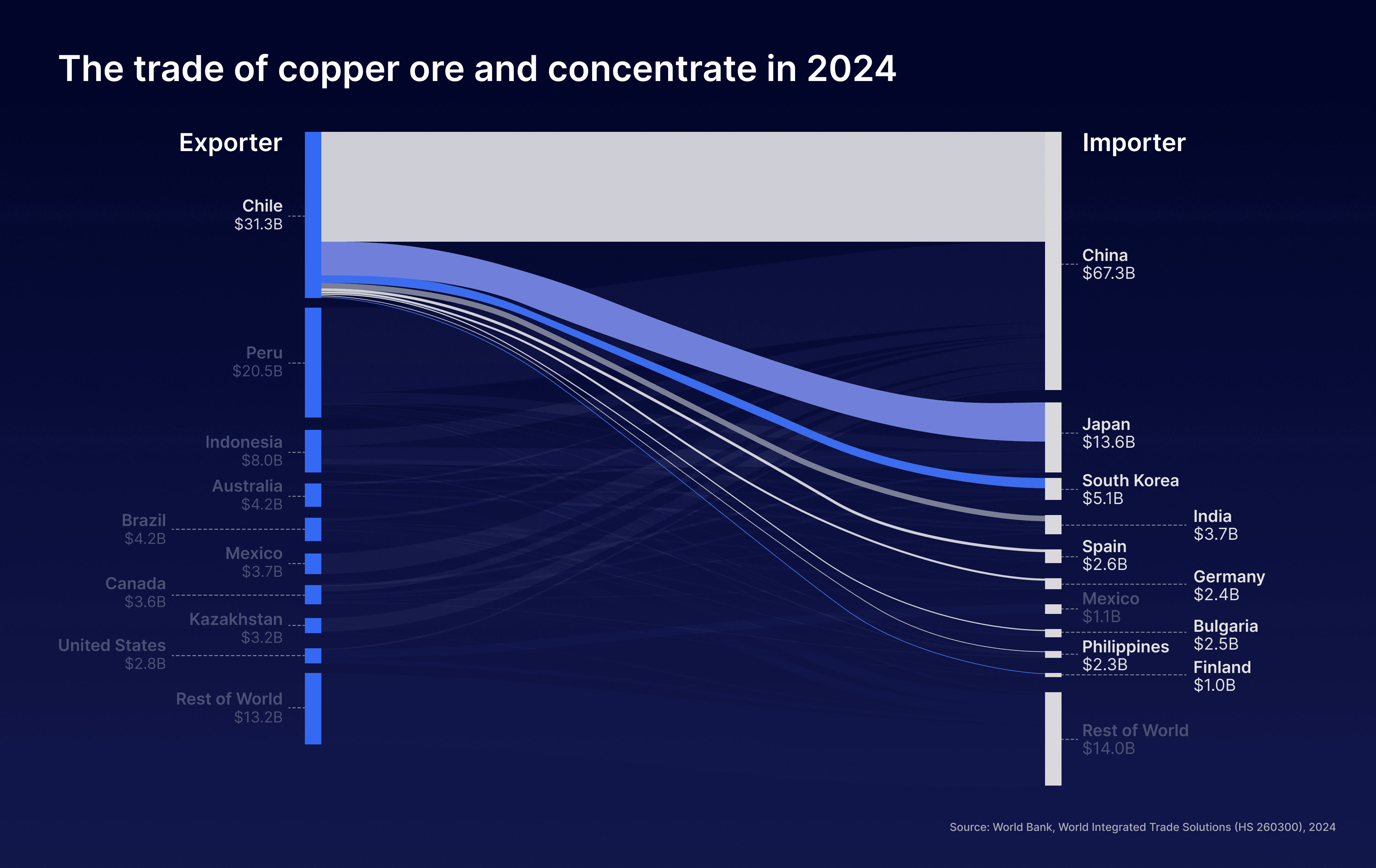
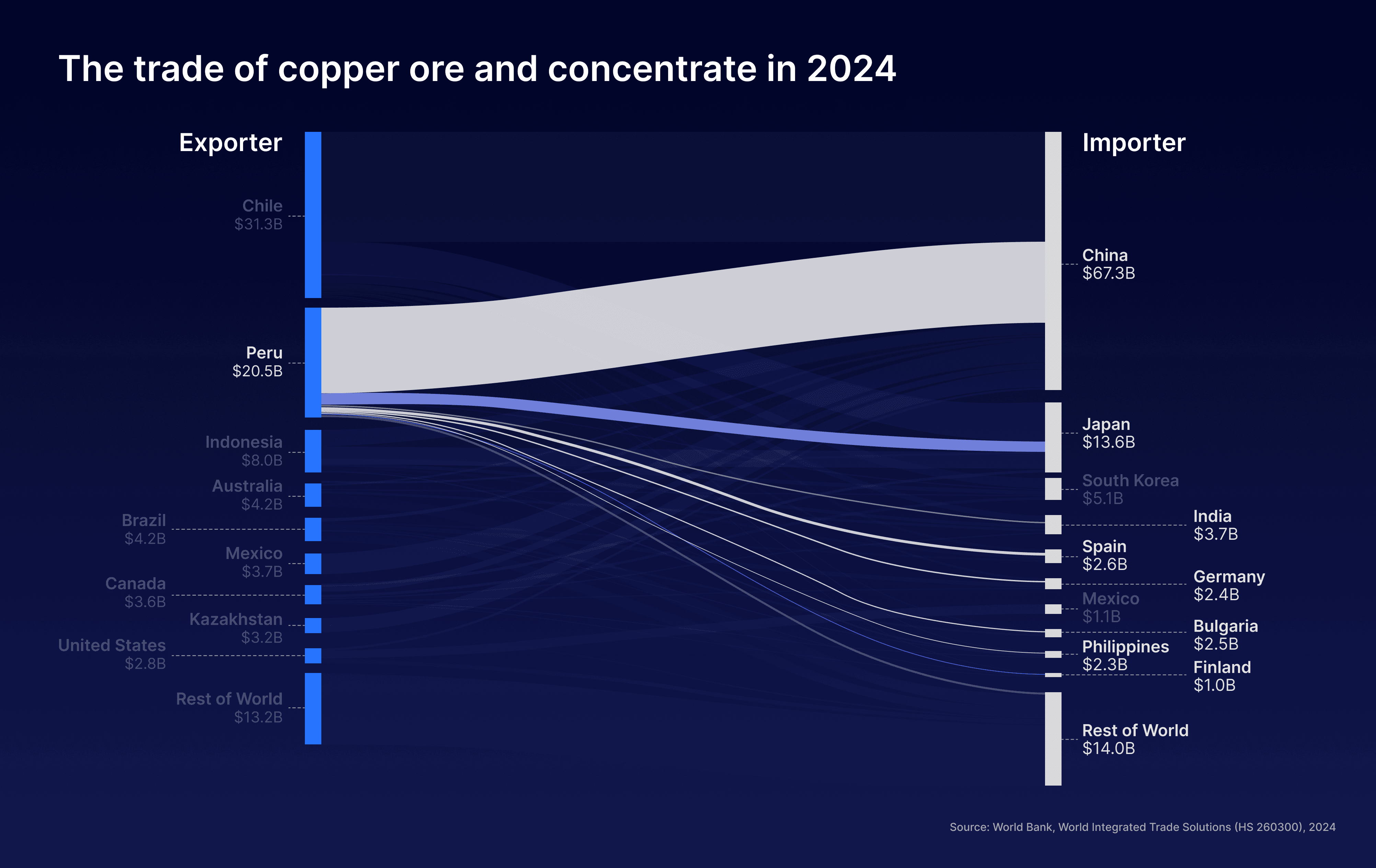
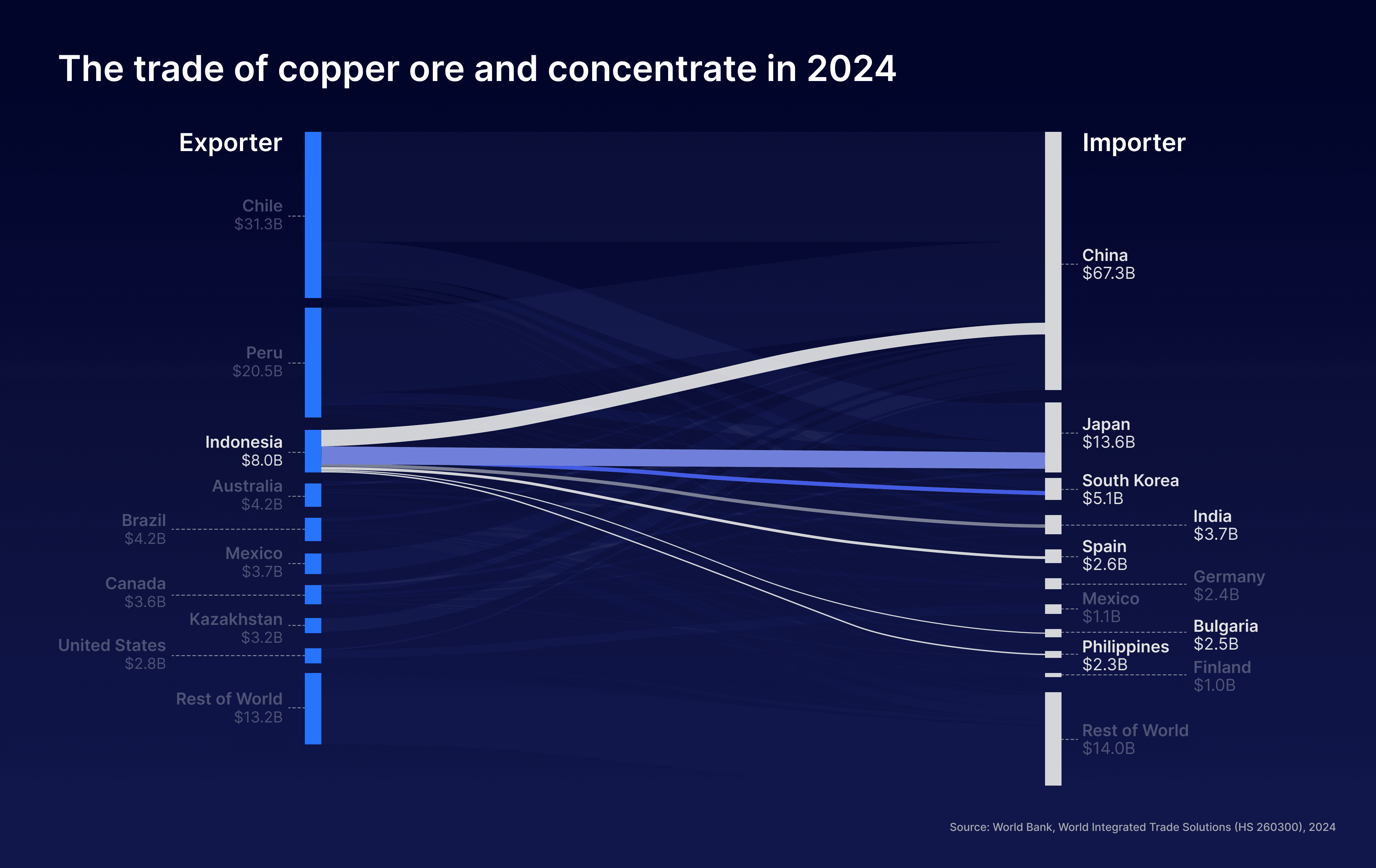
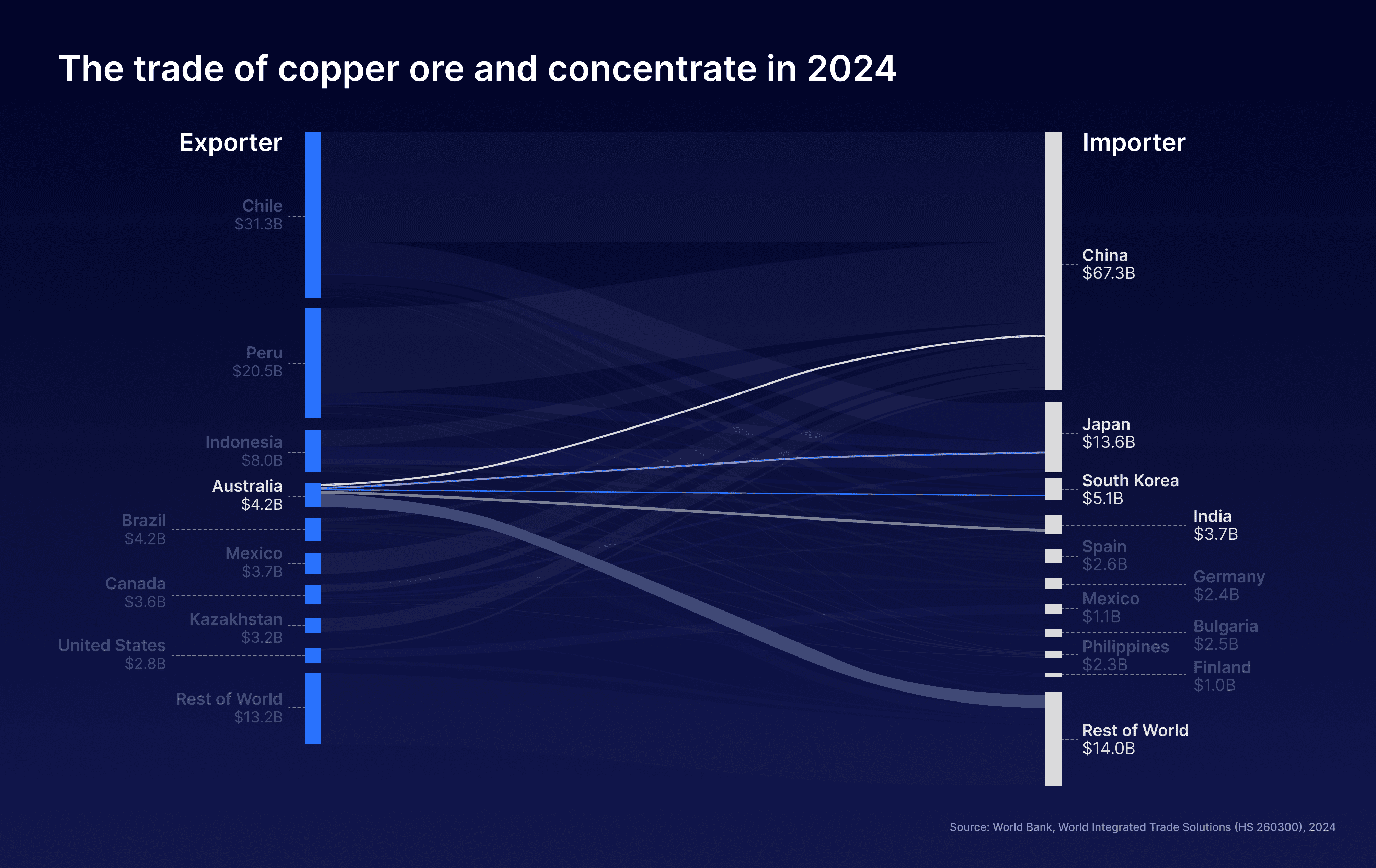
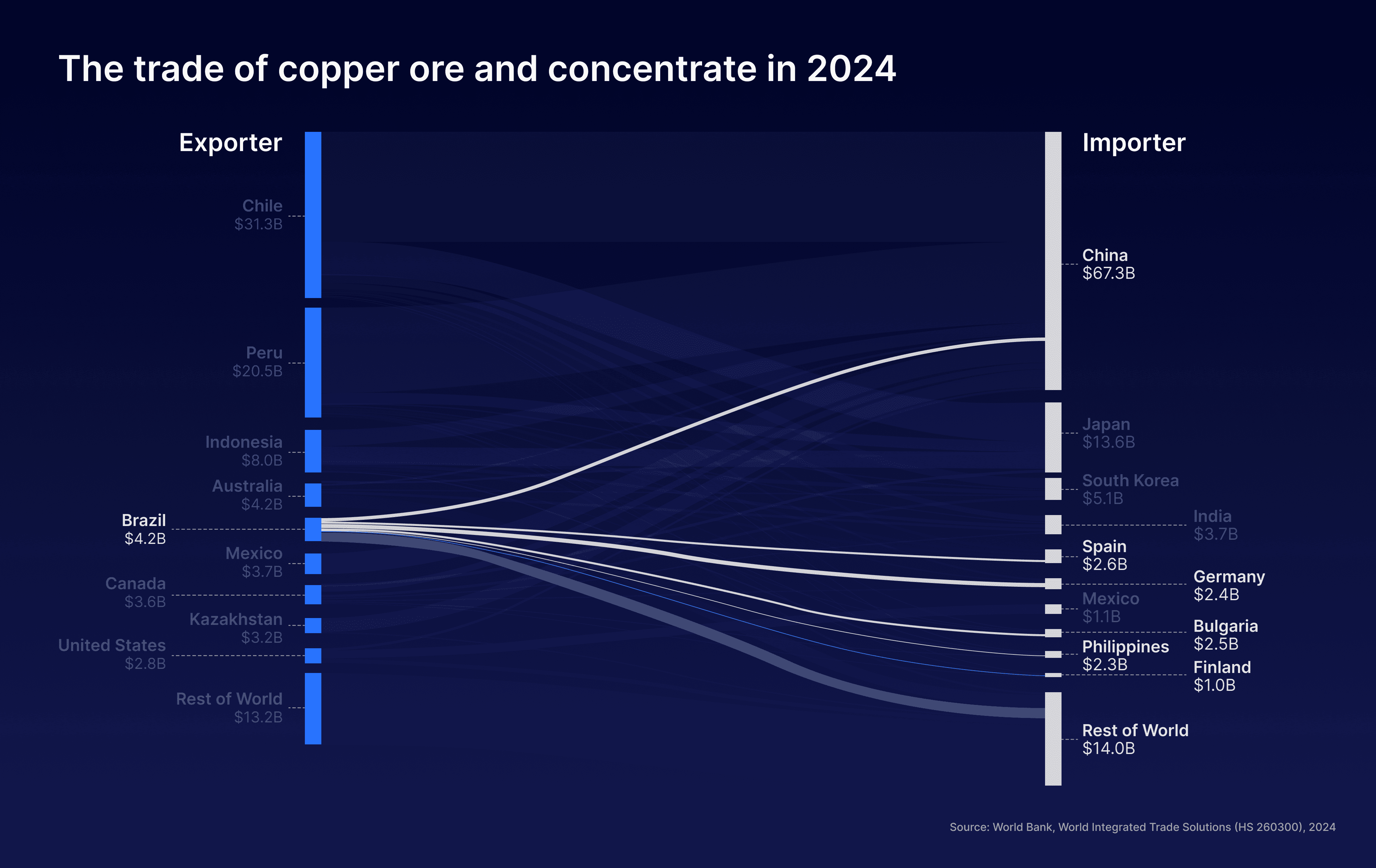
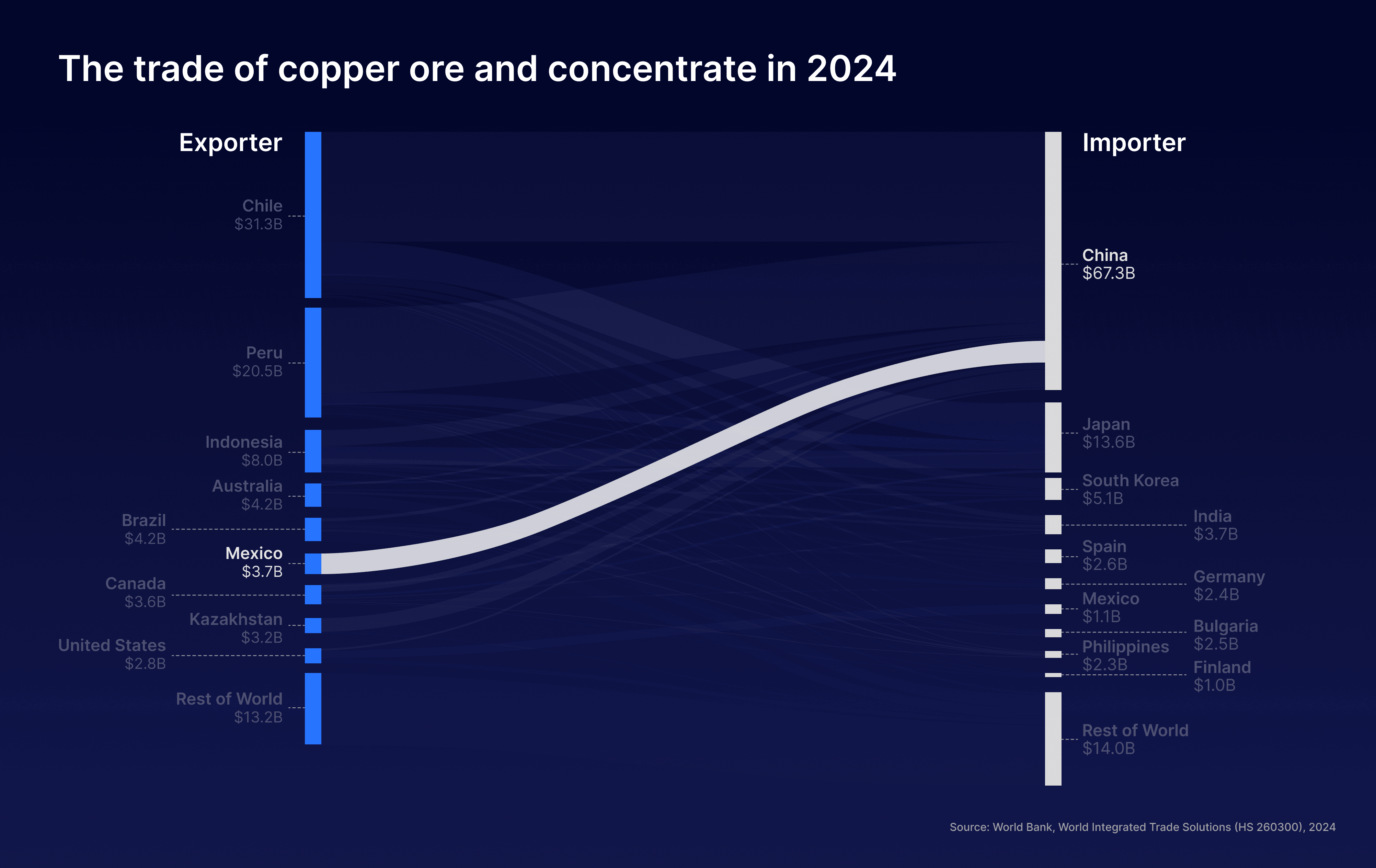

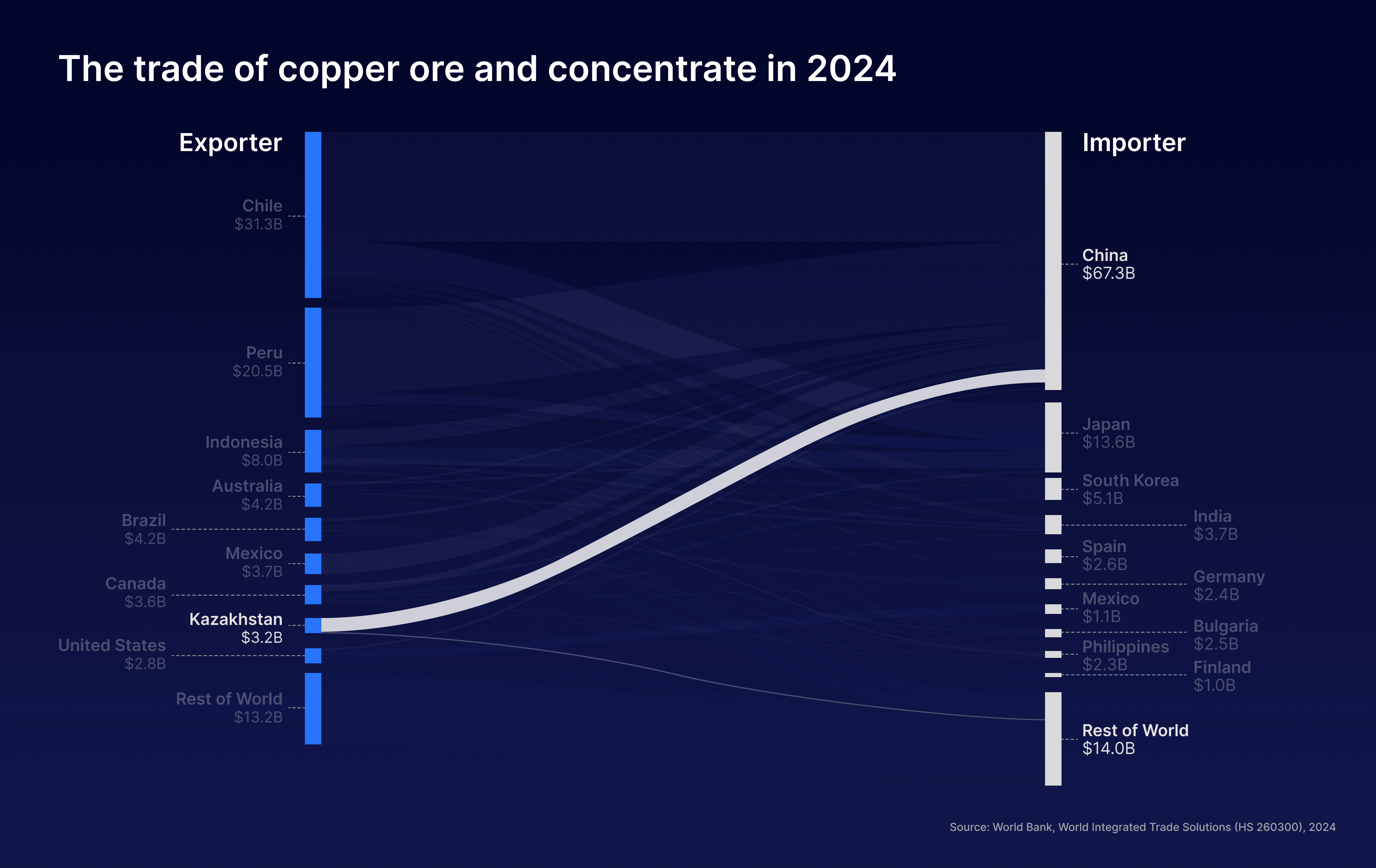
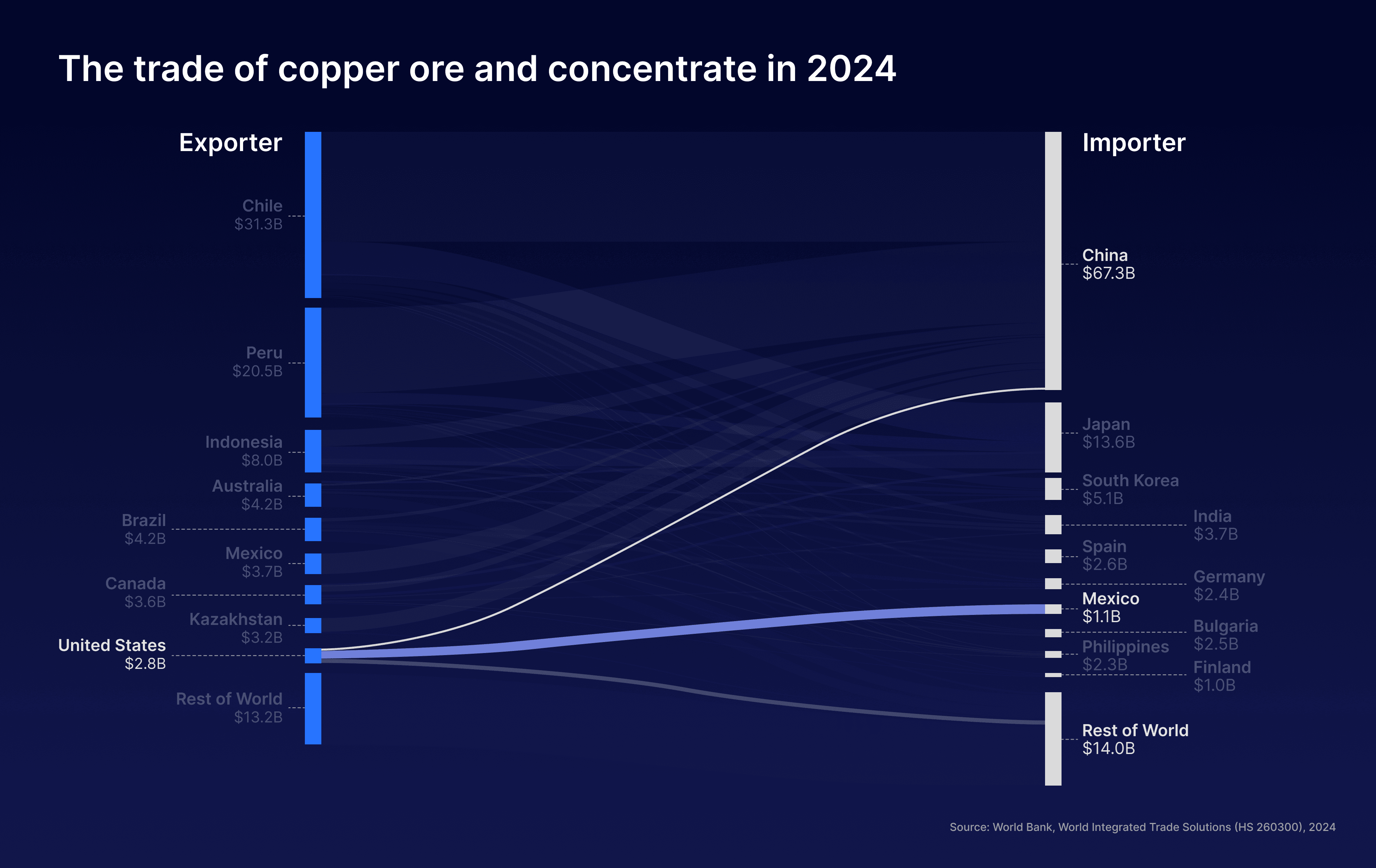
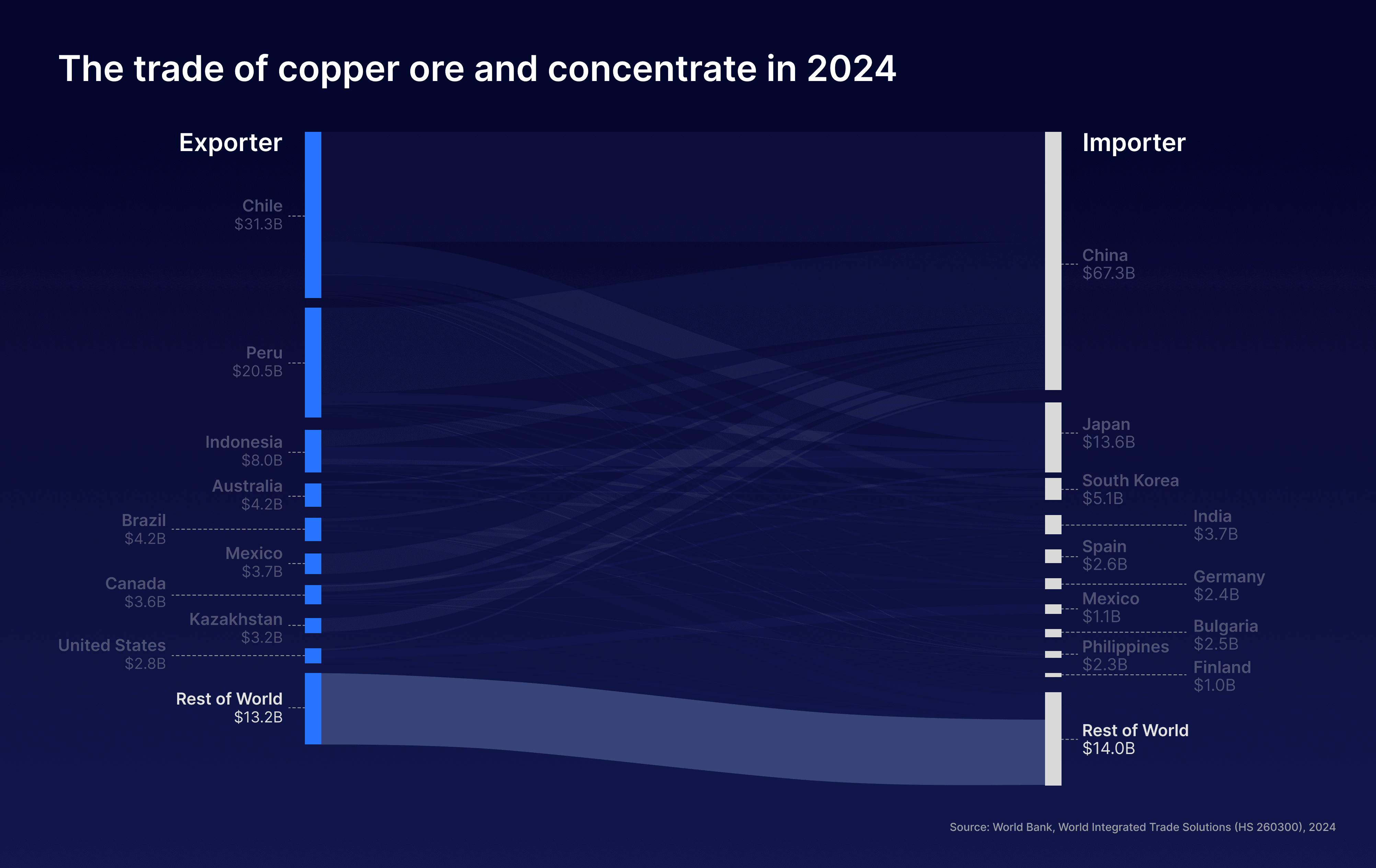

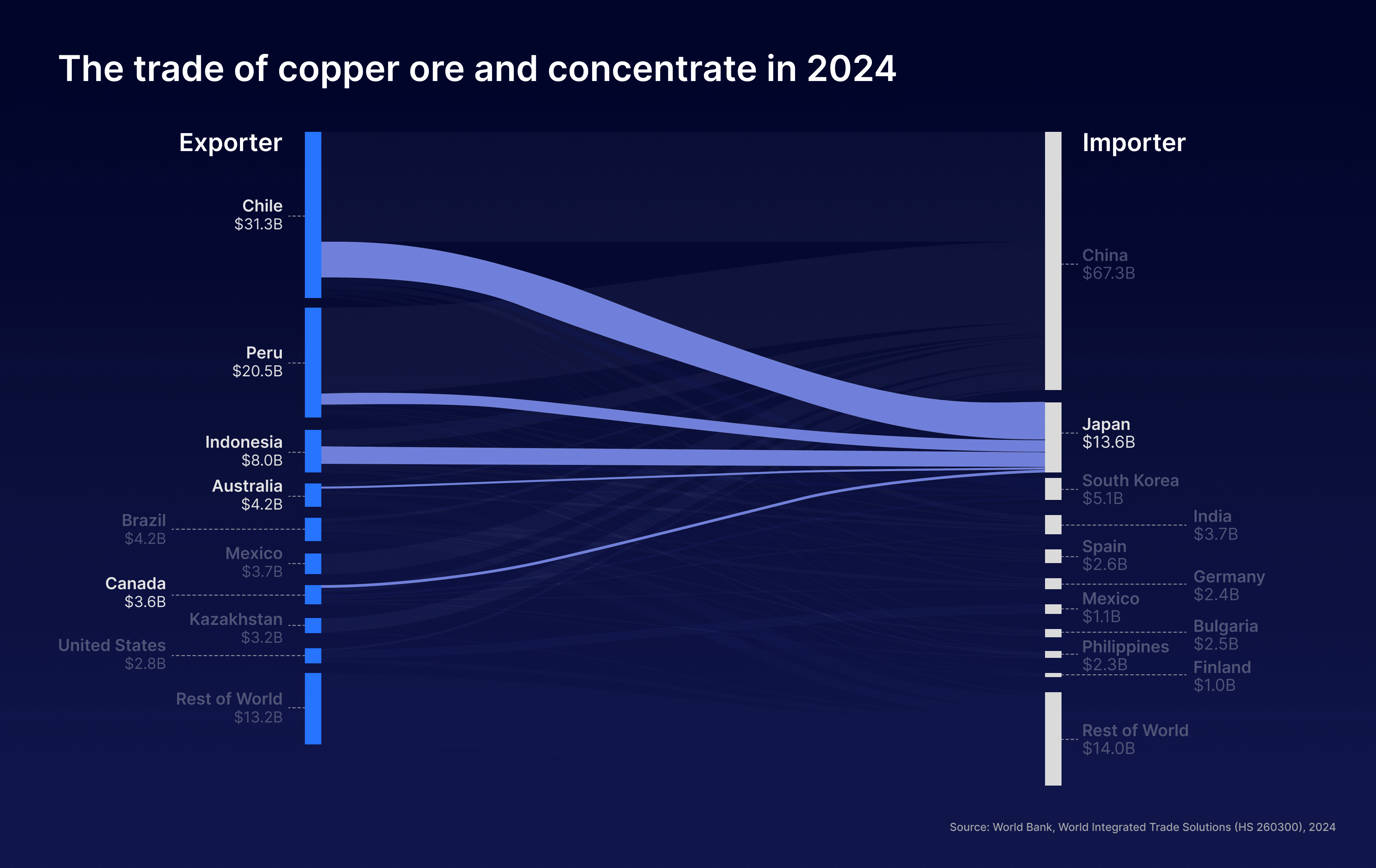
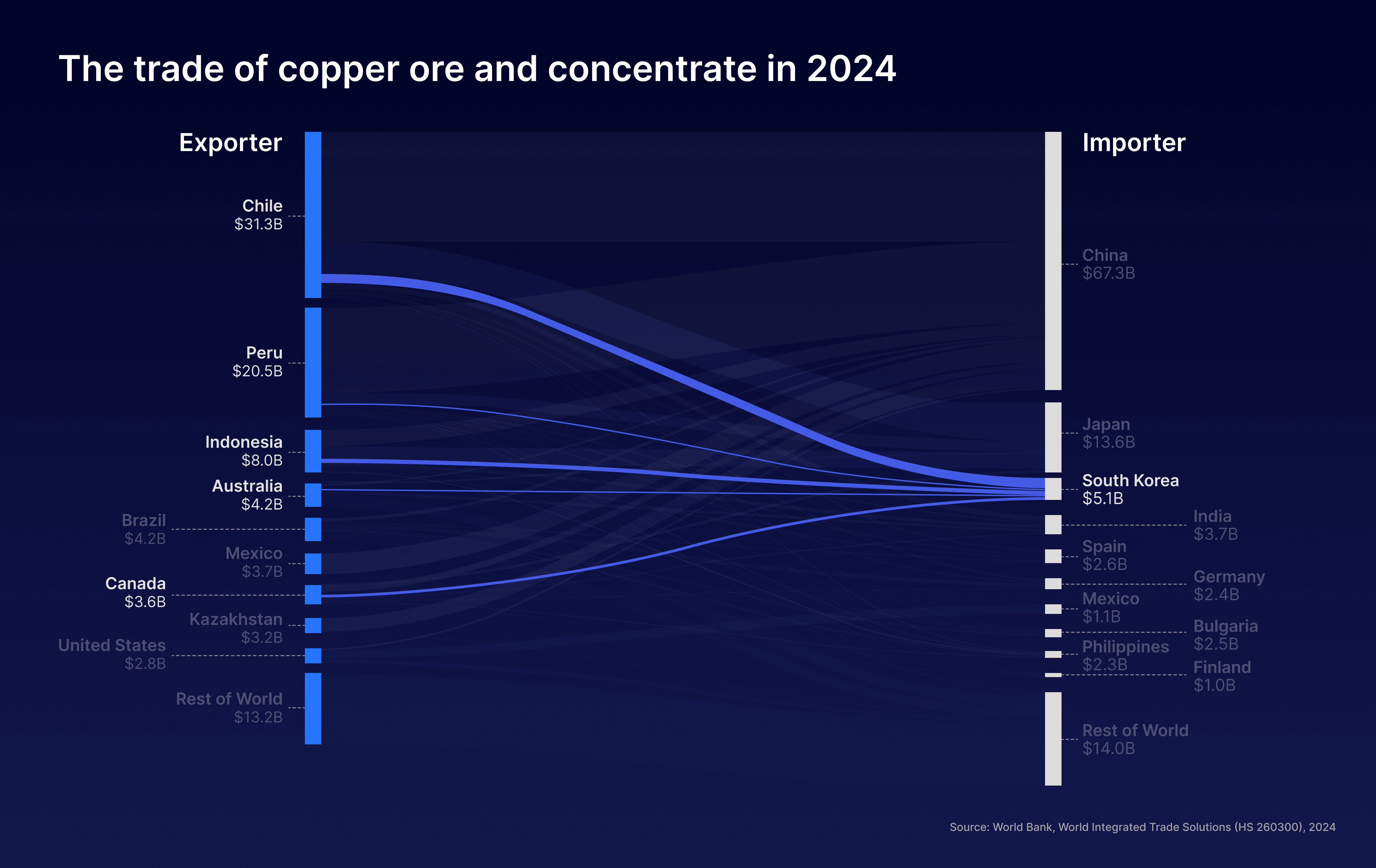
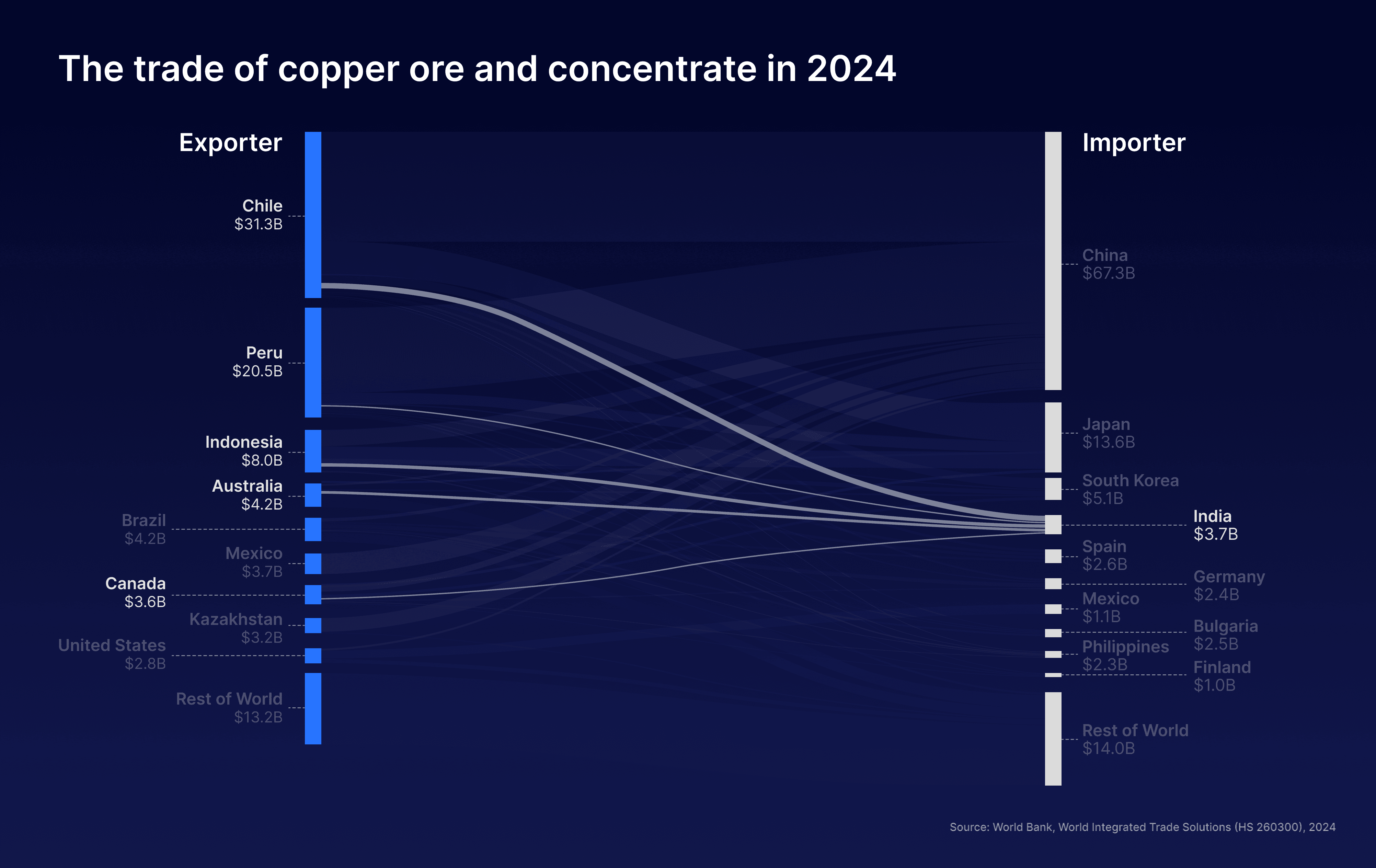
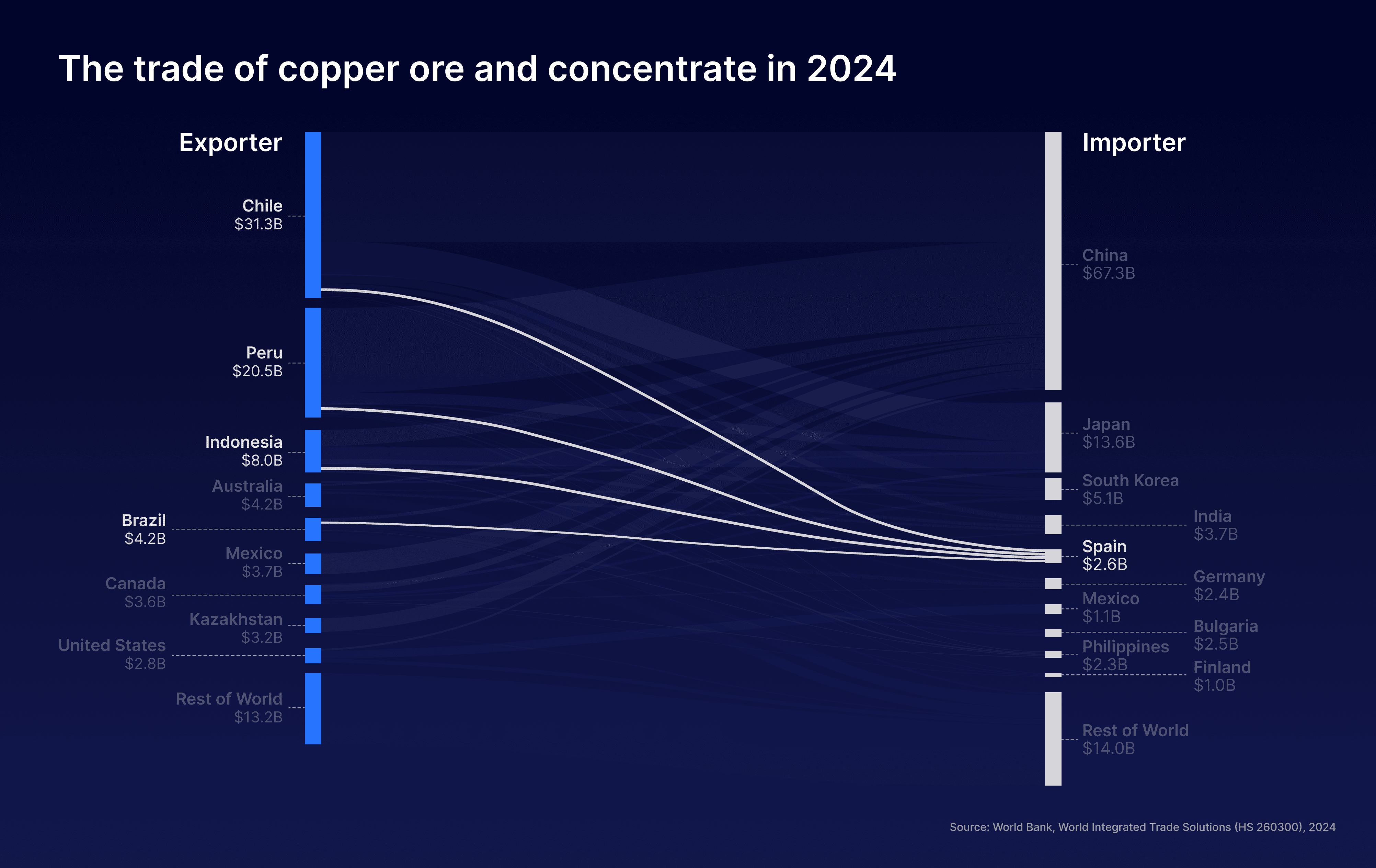
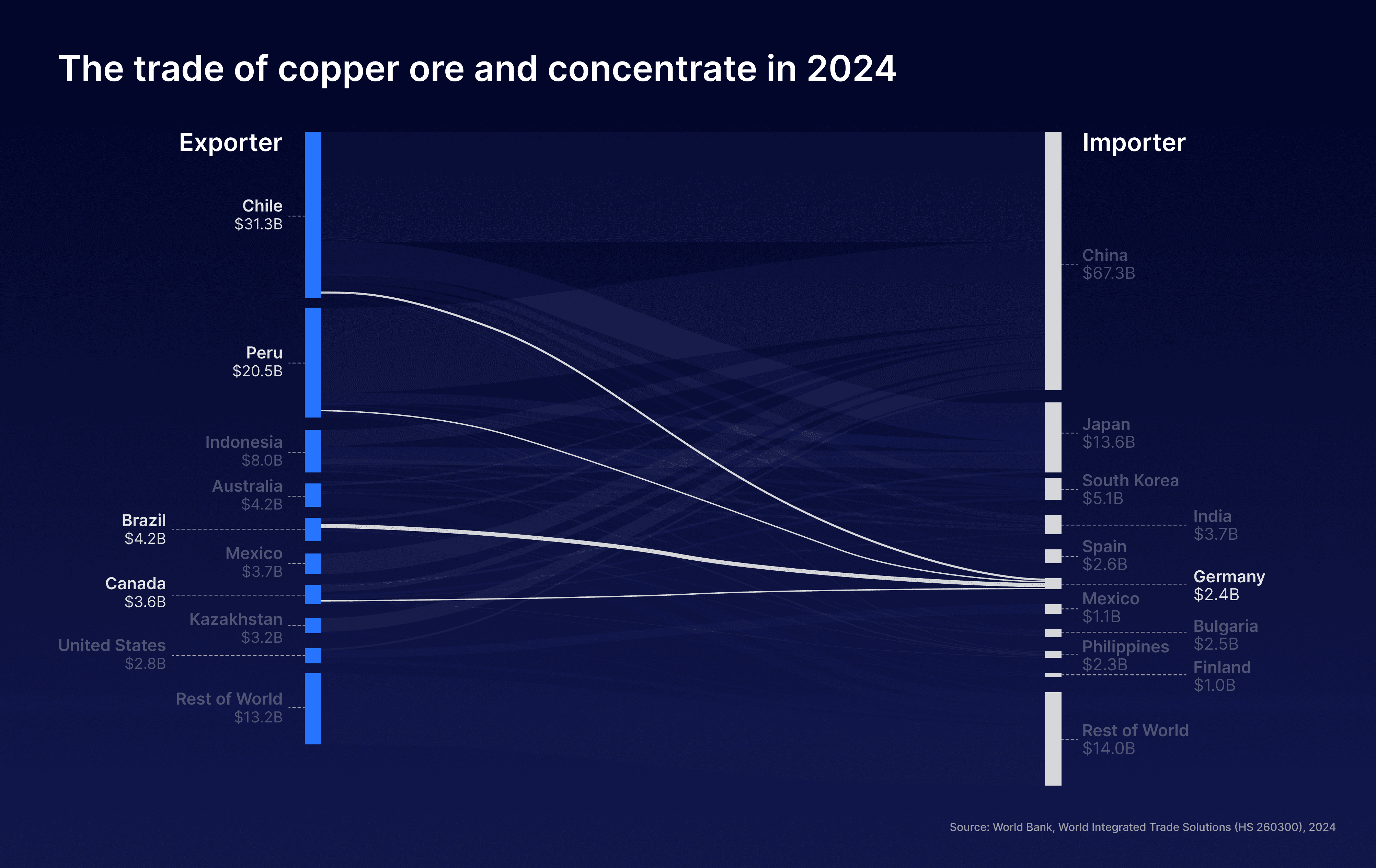
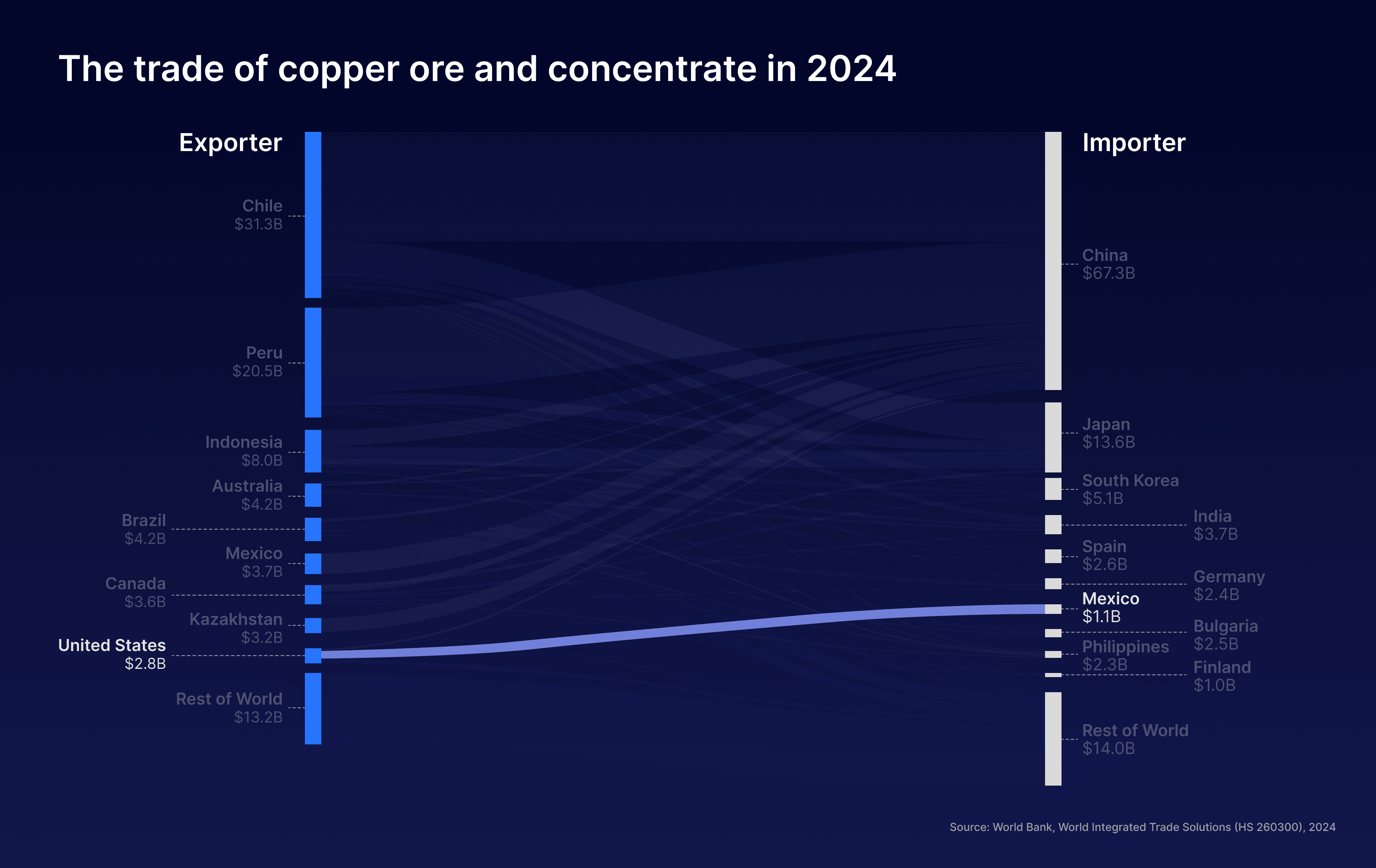
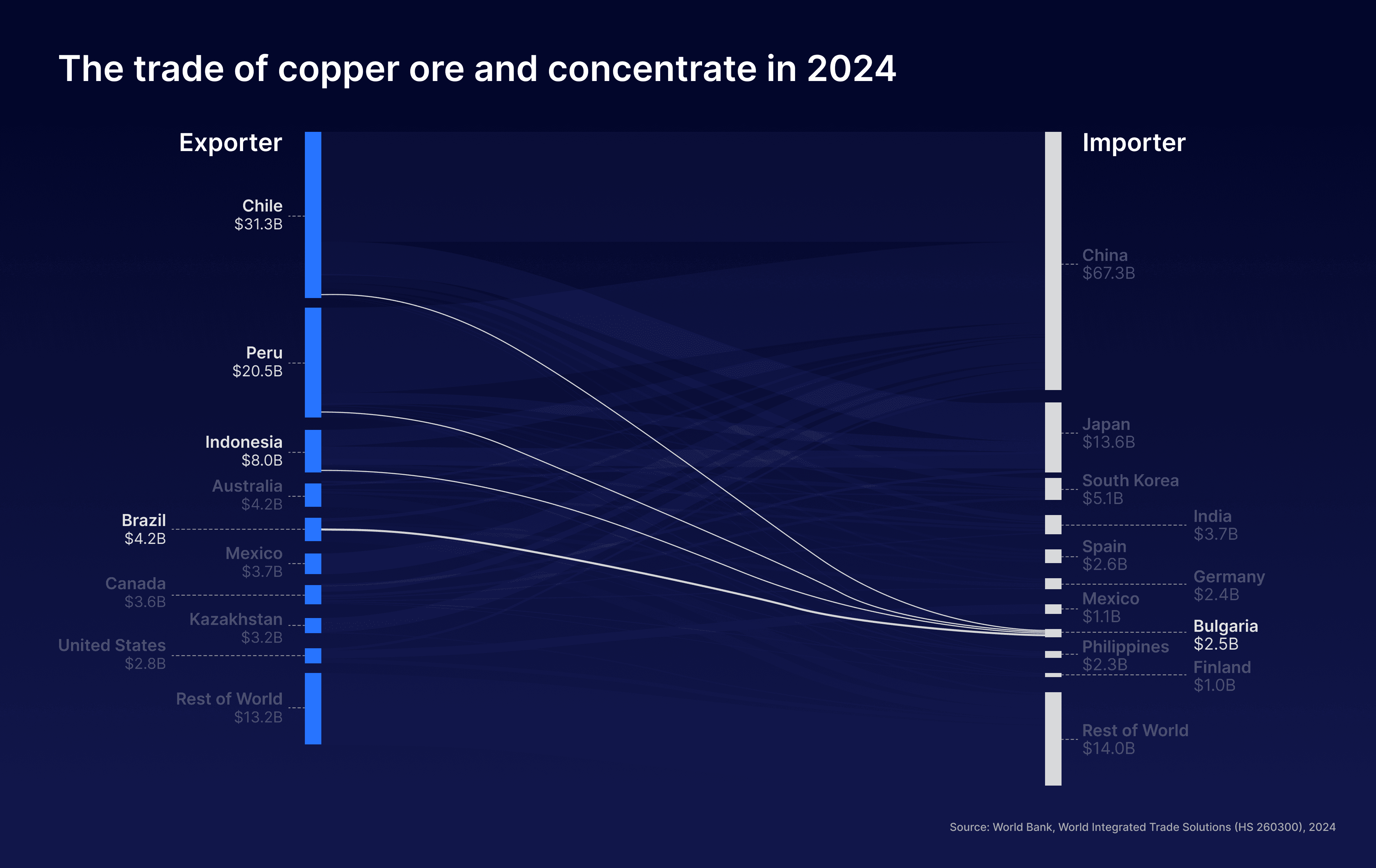
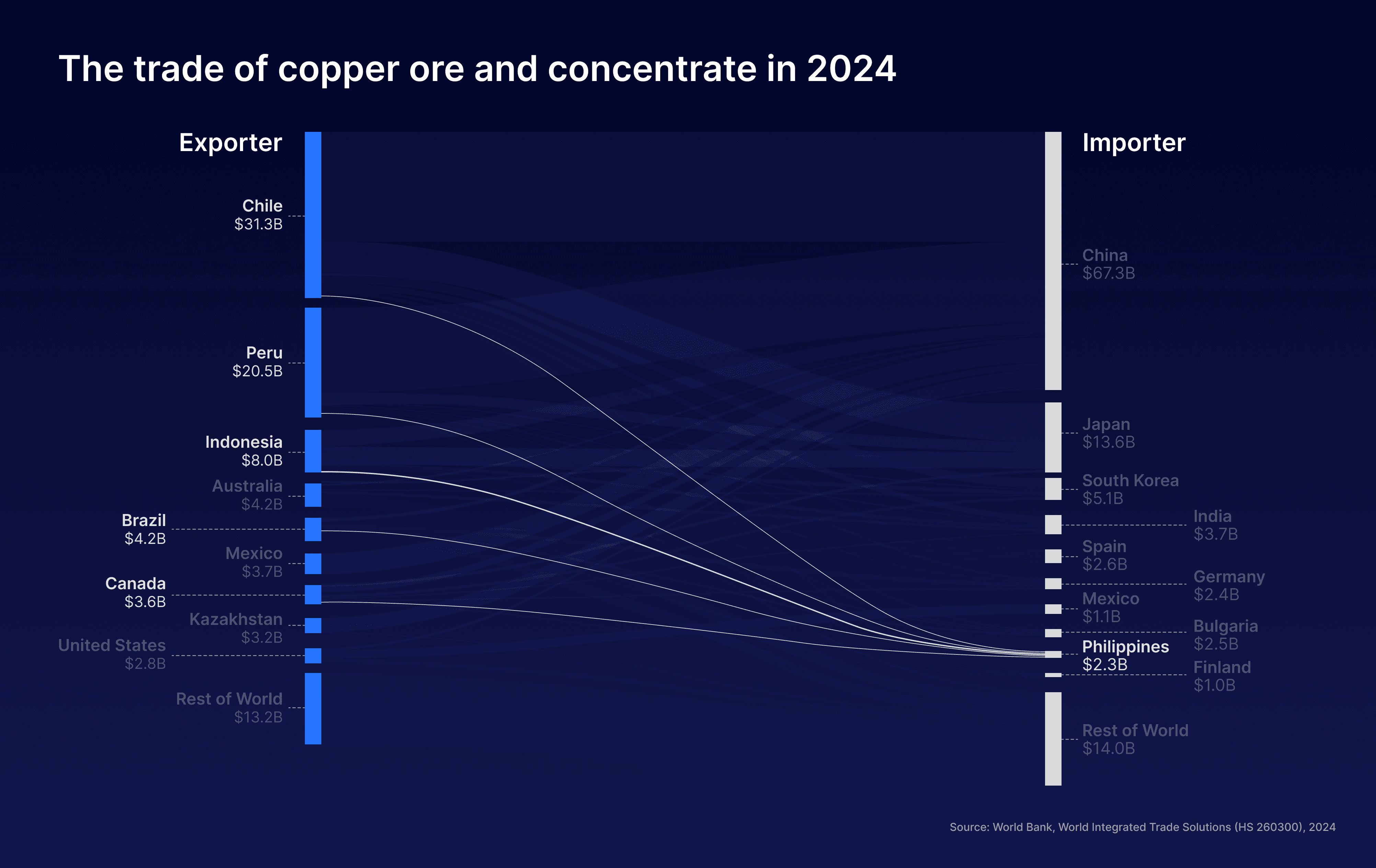
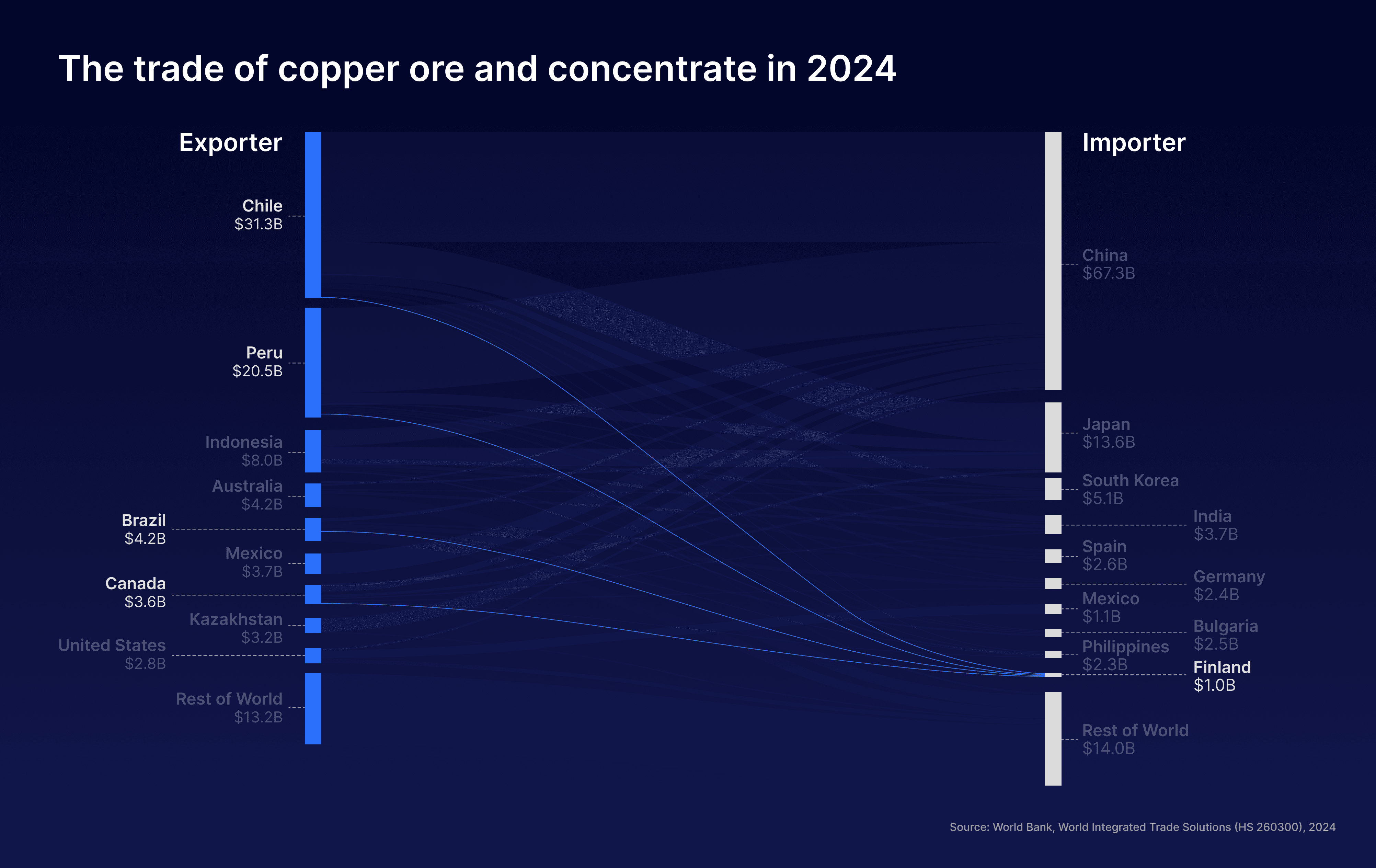
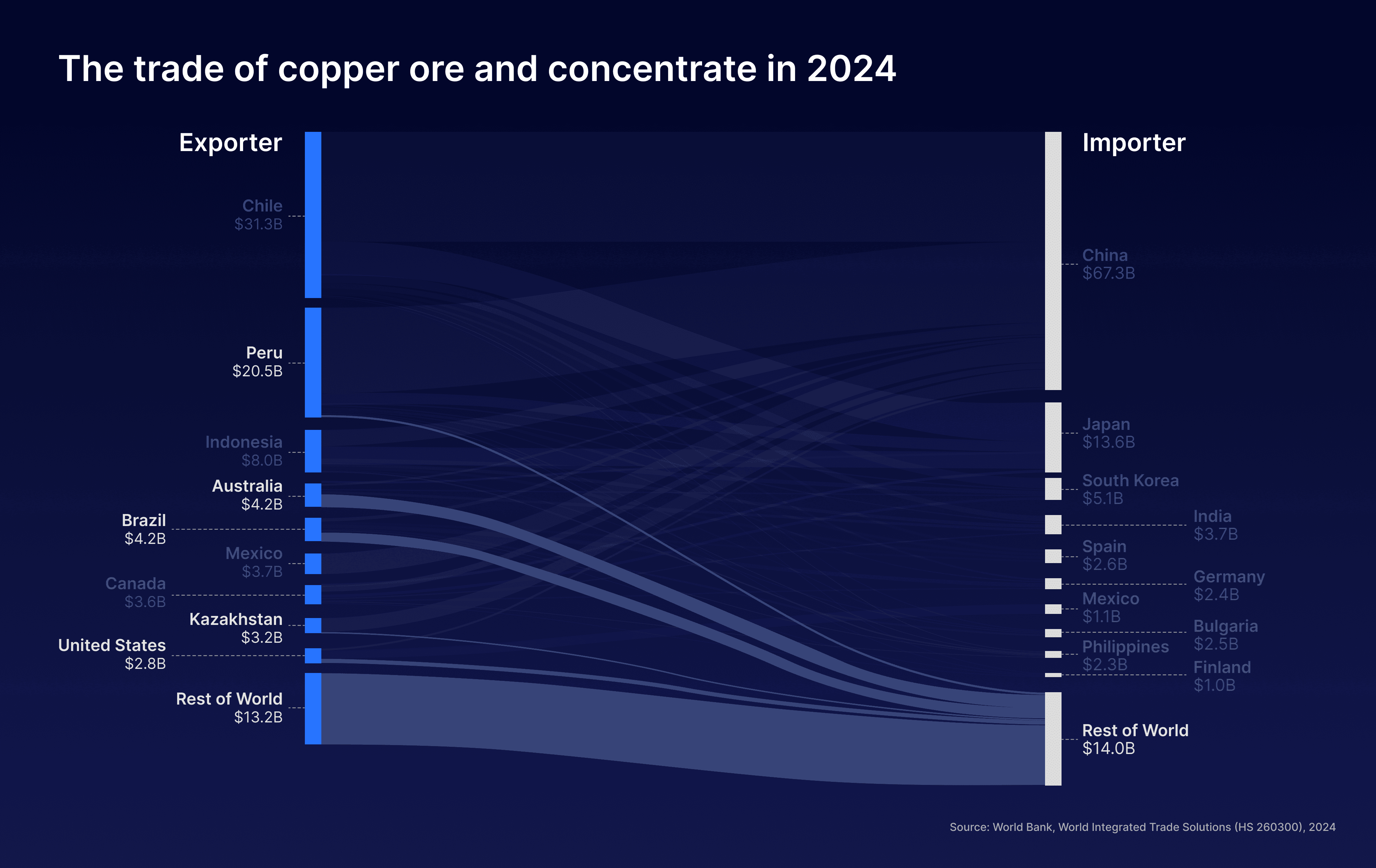
The copper trade has fundamentally shifted over the past decade. Mineral-rich countries in South America export ores and concentrates, while Asian economies import them for smelting and processing into refined copper for electronics, construction, and renewable energy technologies. China is increasingly dominant as the destination for copper concentrates due to its central role in global refining capacity and manufacturing supply chains. The United States and other developed Western countries need increasing amounts of refined copper due to electrification and remain largely importers of the refined units with limited local refining capacity.
The copper trade has fundamentally shifted over the past decade. Mineral-rich countries in South America export ores and concentrates, while Asian economies import them for smelting and processing into refined copper for electronics, construction, and renewable energy technologies. China is increasingly dominant as the destination for copper concentrates due to its central role in global refining capacity and manufacturing supply chains. The United States and other developed Western countries need increasing amounts of refined copper due to electrification and remain largely importers of the refined units with limited local refining capacity.

While the U.S. has some large copper operations, in 2024 we still imported ~50% of our total refined copper needs. This is increasing: over the past 25+ years, our output of refined copper has dropped by ~50%. The chart below, which resembles one that compares U.S. electricity production to electricity production in China, underlines decades of underinvestment, declining domestic capacity, and growing reliance on foreign supply.
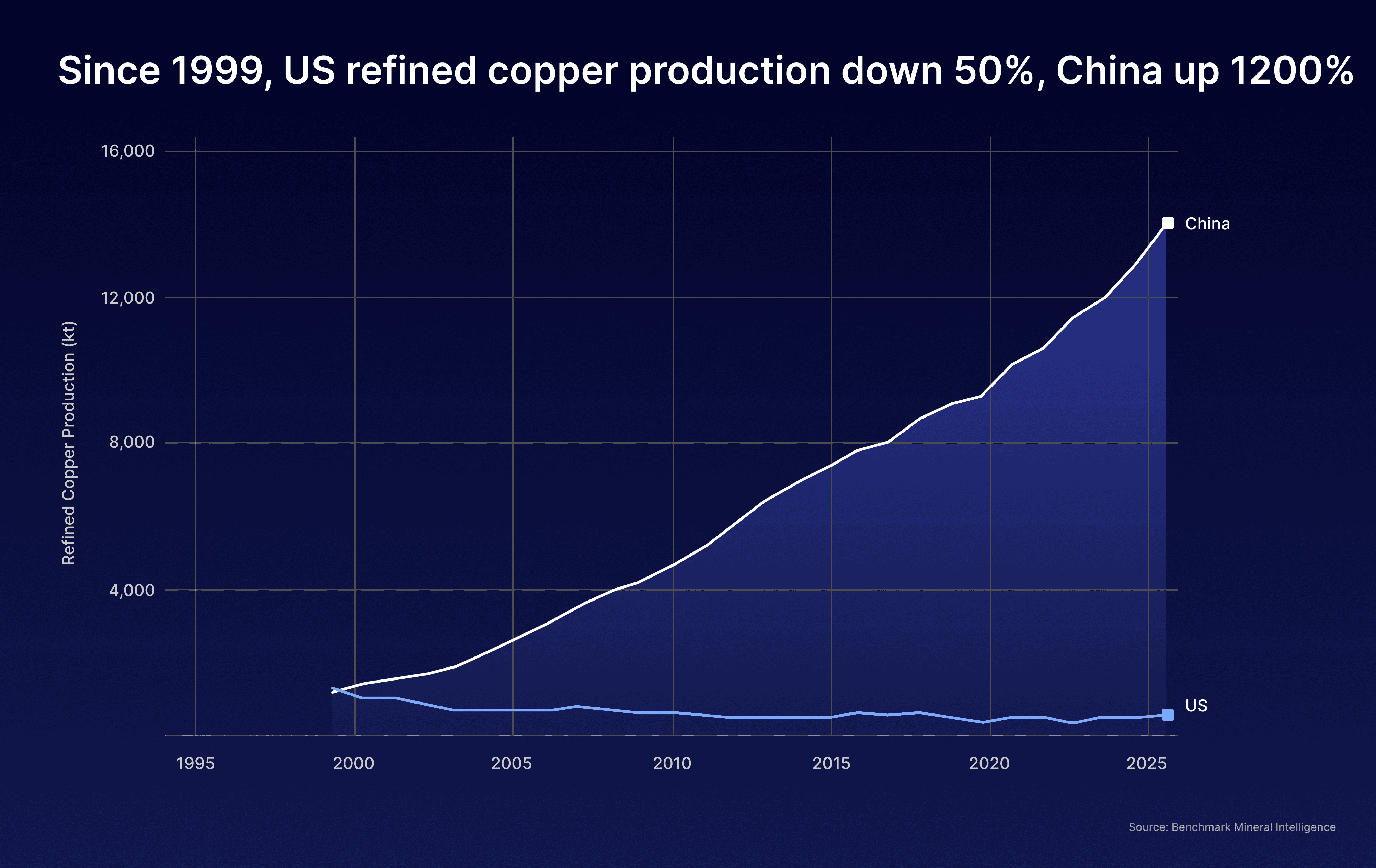

Satisfying domestic copper demand requires both mining and processing capacity. Even when copper is mined domestically or available for recovery through scrap, huge volumes are exported for smelting or refining abroad and then re-imported as refined copper. This processing bottleneck, combined with rising demand from electrification, renewable energy systems, and data centers, has created a structural deficit that cannot be solved by mining alone. The U.S. needs expanded domestic recycling, refining, and smelting capacity to close the gap.
While the U.S. has some large copper operations, in 2024 we still imported ~60% of our total refined copper needs. This is increasing: over the past 25+ years, our output of refined copper has dropped by ~50%. The chart below, which resembles one that compares U.S. electricity production to electricity production in China, underlines decades of underinvestment, declining domestic capacity, and growing reliance on foreign supply.
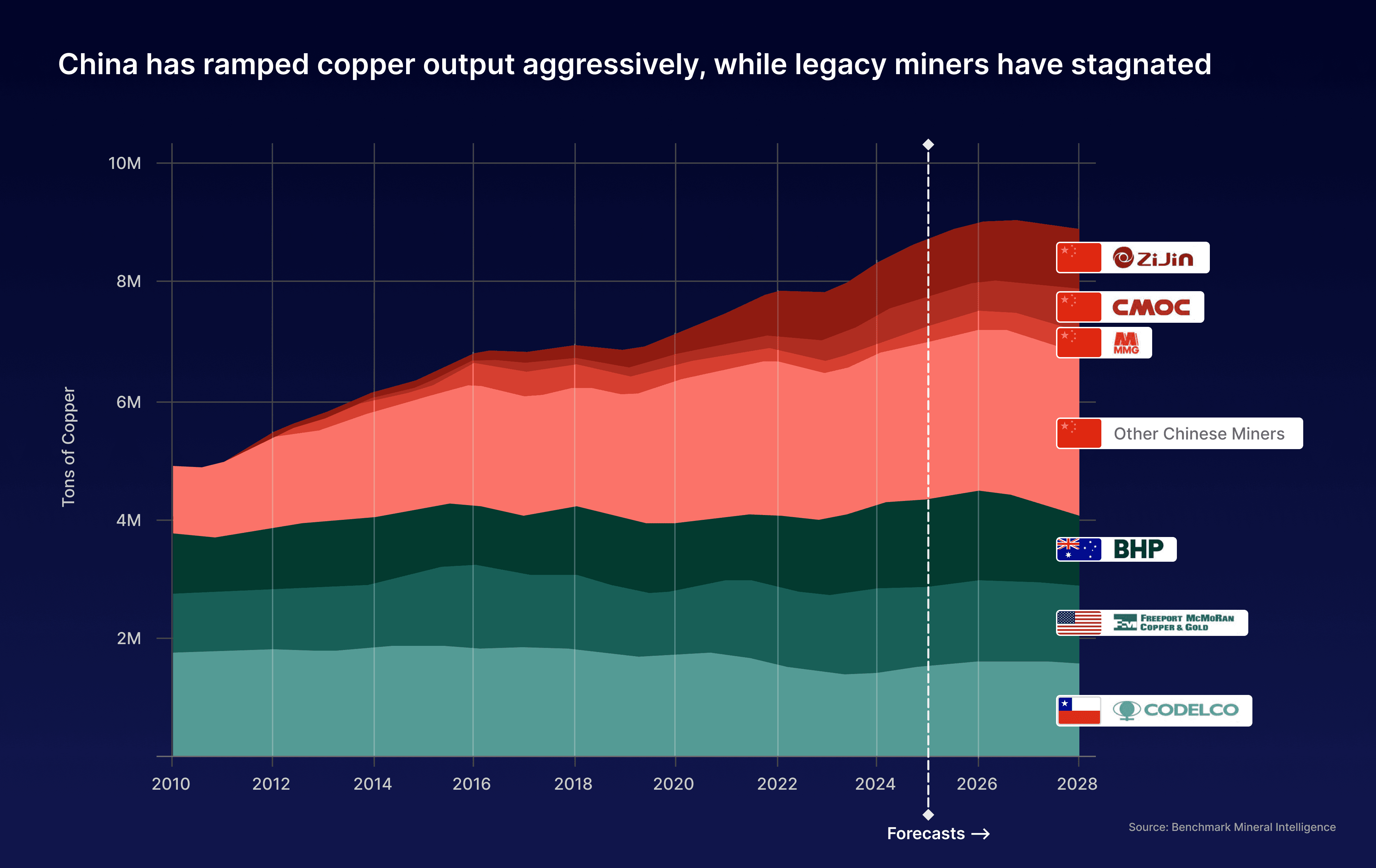
The issue isn’t isolated to the U.S. Over the past 25 years, major Western copper producers globally have struggled just to maintain output, while Chinese companies have scaled globally to levels that today exceed the combined production capacity of their Western counterparts.
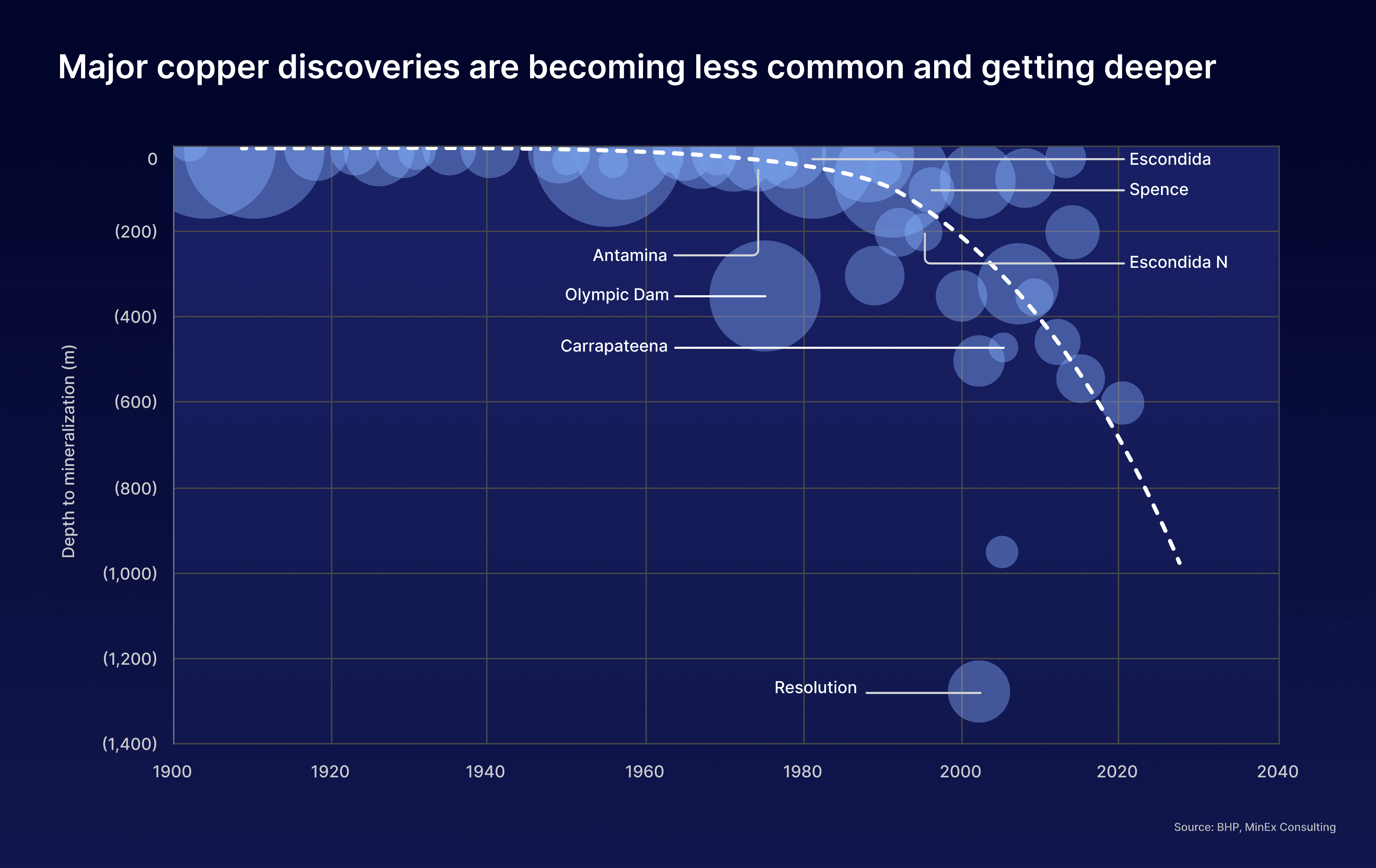
The number of large copper discoveries has declined sharply since the 1990s, and the deposits we do find are deeper and harder to develop. The industry's reserve growth mostly comes from expanding existing deposits rather than finding new ones.
The remaining undeveloped deposits are often located far below the surface, requiring advanced underground mining methods and massive capital investments. The Resolution Copper project in Arizona—one of the largest undeveloped copper deposits in North America—targets an orebody located more than 1,600 meters underground. Some of the project's mine shafts extend beyond 2,100 meters (deeper than 5 Empire State Buildings stacked on top of each other!) requiring ultra-deep block-cave mining to extract the resource.
These trends mean new copper supply increasingly depends on deeper, more complex projects that take longer to permit, finance, and construct. The pace at which new supply can come online is slowing, while demand continues to accelerate (note – autonomy is a solution for this, too, but we’ll save that for later).
It is getting harder to scale copper output, not easier.
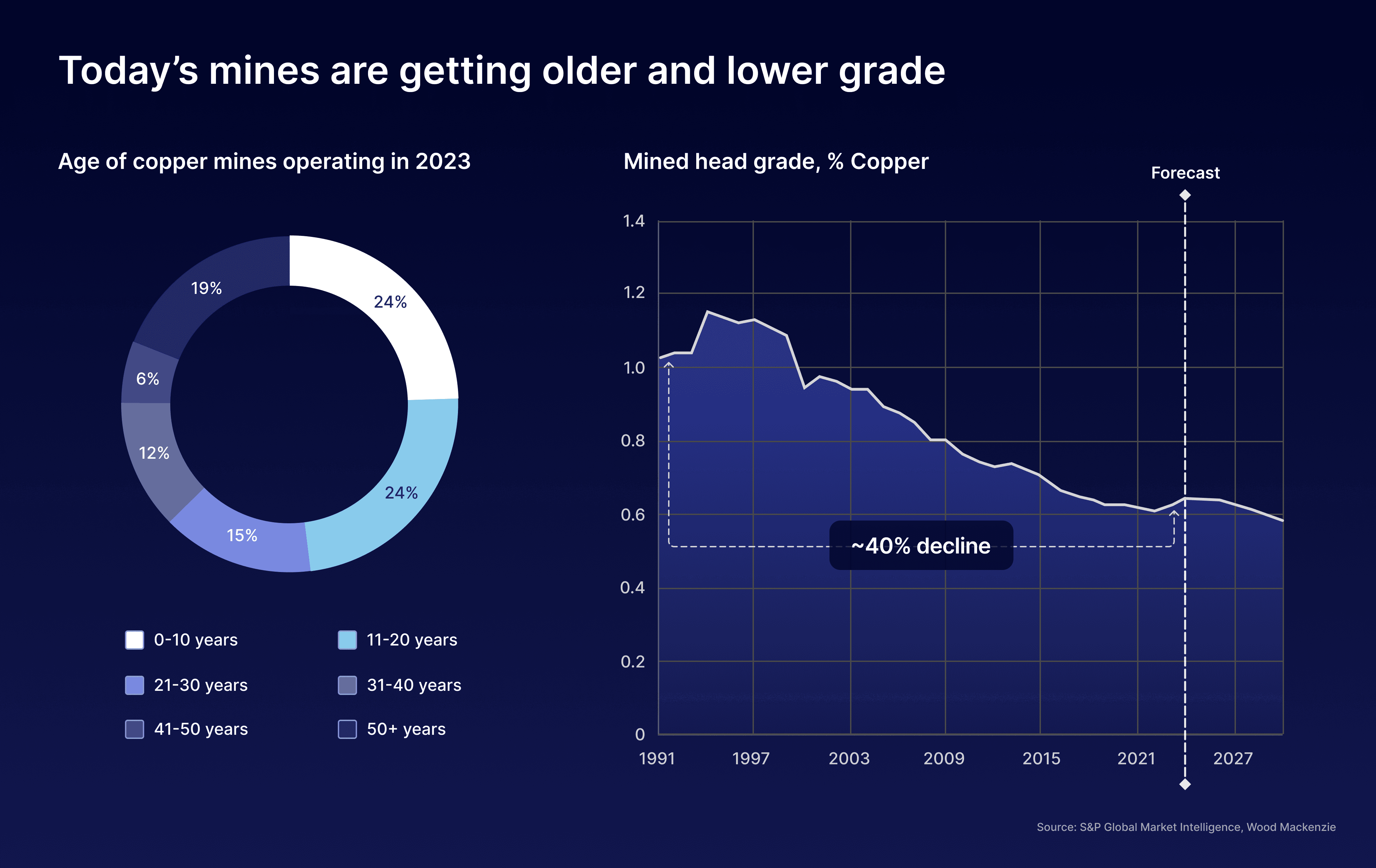
Miners extract their most economic resources first, targeting the highest-grade ore for extraction. As copper mines age, the grade of the remaining resource reduces. More than half of operating copper mines globally are over 20 years old, forcing operators to mine more material to produce the same amount of copper each year. This presents a structural issue that must be addressed with new mines and new mining and refining technologies to reduce costs.
It is getting harder to scale copper output, not easier.
The number of large copper discoveries has declined sharply since the 1990s, and the deposits we do find are deeper and harder to develop. The industry's reserve growth mostly comes from expanding existing deposits rather than finding new ones.
The remaining undeveloped deposits are often located far below the surface, requiring advanced underground mining methods and massive capital investments. The Resolution Copper project in Arizona - one of the largest undeveloped copper deposits in North America - targets an orebody located more than 1,600 meters underground. Some of the project's mine shafts extend beyond 2,100 meters (deeper than 5 Empire State Buildings stacked on top of each other!), requiring ultra-deep block-cave mining to extract the resource.
These trends mean new copper supply increasingly depends on deeper, more complex projects that take longer to permit, finance, and construct. The pace at which new supply can come online is slowing, while demand continues to accelerate (note – autonomy is a solution for this, too, but we’ll save that for later).
Miners extract their most economic resources first, so as copper mines age, the grade of the remaining resource reduces. More than half of operating copper mines are over 20 years old, forcing operators to mine more material to produce the same amount of copper each year. This presents a structural issue that must be addressed with new mines and new mining and refining technology to reduce costs.
As mines get deeper and ore mineralogy becomes more challenging, cost and complexity increase non-linearly. Capital requirements balloon. Permitting timelines stretch. Operating expenses and optimization challenges compound. Meanwhile, the pool of skilled labor in the West shrinks, particularly among those able to engineer, execute, ramp production, and optimize metallurgical processing circuits, increasing the delay of bringing new copper production online (as we called out in our Series A announcement).
As mines get deeper and ore mineralogy becomes more challenging, cost and complexity increase non-linearly. Capital requirements balloon. Permitting timelines stretch. Operating expenses and optimization challenges compound. Meanwhile, the pool of skilled labor in the West shrinks, particularly among those able to engineer, execute, ramp production, and optimize metallurgical processing circuits, increasing the delay of bringing new copper production online (as we called out in our Series A announcement).

The time to invest in and scale copper production is now.
The global copper supply system is under mounting pressure. Existing operations are harder to sustain. New sources of supply are more difficult, expensive, and time-consuming to bring online. Meanwhile, demand accelerates from electrification, renewable energy, grid expansion, and industrial growth.
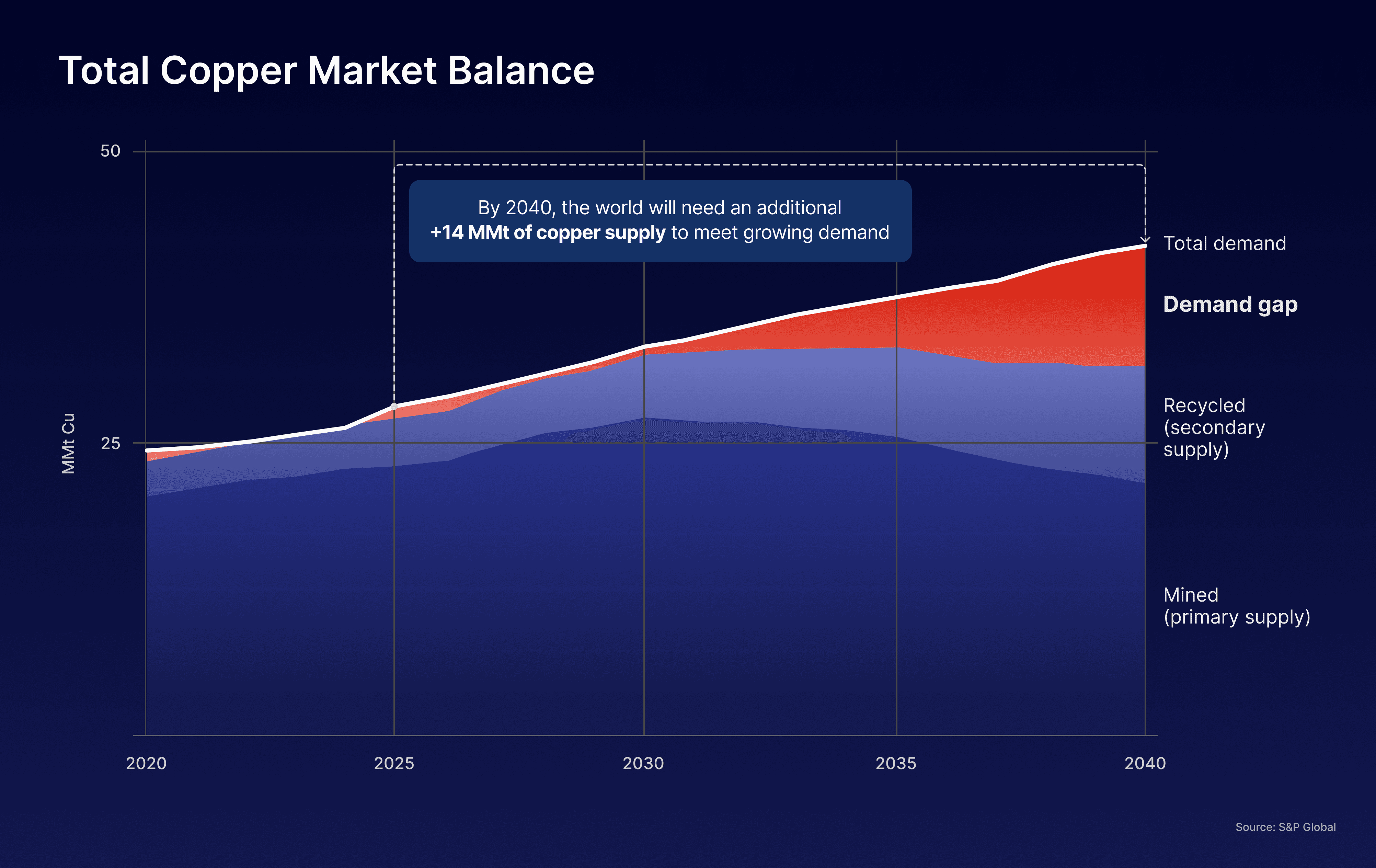
The combination of geological limits, technical complexity, and long development timelines means supply will struggle to keep pace. Market forecasts anticipate a substantial structural shortfall - some projections suggest a deficit approaching 10 million metric tons if new capacity fails to materialize quickly enough.
We're faced with a bleak outlook: demand is accelerating while supply struggles to keep pace. The gap is widening. Closing this gap requires a fundamentally different approach to mining and refining - one built on autonomy, software, and operational intelligence.
Today, autonomous vehicles navigate cities. We launch and land rockets autonomously. Autonomous weapons will soon define the battlefield, and humanoid robots will soon deliver services in factories and at home. Mariana Copper One is the first mine in the world that will demonstrate what end-to-end autonomy will deliver in mining.
The time to invest in and scale copper production is now.
The global copper supply system is under mounting pressure. Existing operations are harder to sustain. New sources of supply are more difficult, expensive, and time-consuming to bring online. Meanwhile, demand accelerates from electrification, renewable energy, grid expansion, and industrial growth.
The combination of geological limits, technical complexity, and long development timelines means supply will struggle to keep pace. Market forecasts anticipate a substantial structural shortfall - some projections suggest a deficit approaching 10 million metric tons if new capacity fails to materialize quickly enough.
We're faced with a bleak outlook: demand is accelerating while supply struggles to keep pace. The gap is widening. Closing this gap requires a fundamentally different approach to mining and refining - one built on autonomy, software, and operational intelligence.
Today, autonomous vehicles navigate cities. We launch and land rockets autonomously. Autonomous weapons will soon define the battlefield, and humanoid robots will soon deliver services in factories and at home. Mariana Copper One is the first mine in the world that will demonstrate what end-to-end autonomy will deliver in mining.
Mariana Copper One: the only autonomy-first copper mine and refinery.
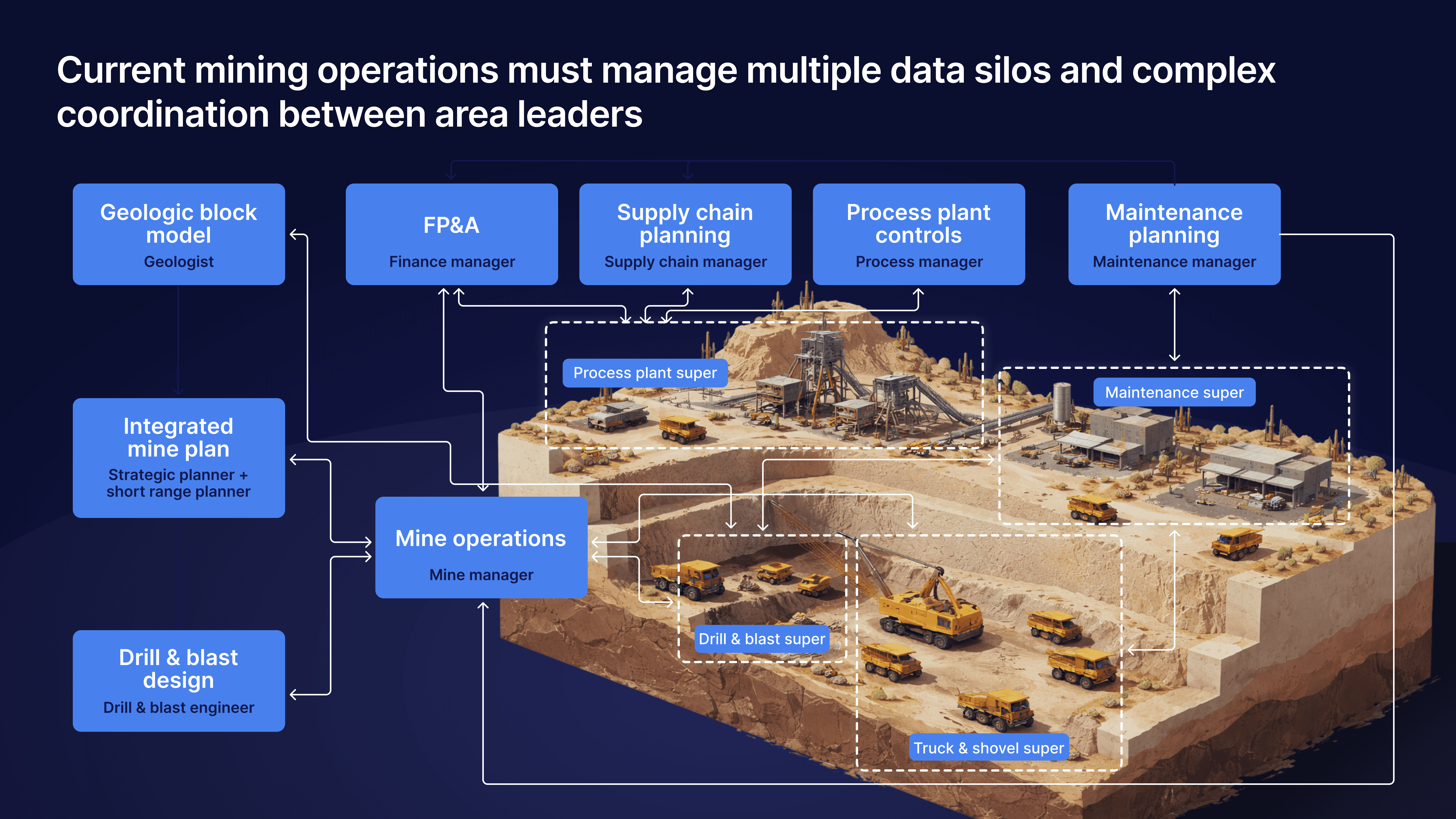
Mining and refining operations require thousands of cross-functional decisions daily. Today those decisions are informed by fragmented data management systems and driven by human intuition. This leads to significant shift-to-shift performance variability and exposes the major challenge we face today: we don’t have enough people that know how to operate and optimize these complex systems.
Mariana Copper One: the only autonomy-first copper mine and refinery.
Mining and refining operations require thousands of cross-functional decisions daily. Today those decisions are informed by fragmented data management systems and driven by human intuition. This leads to significant shift-to-shift performance variability and exposes the major challenge we face today: we don’t have enough people that know how to operate and optimize these complex systems.
MarianaOS breaks this paradigm.
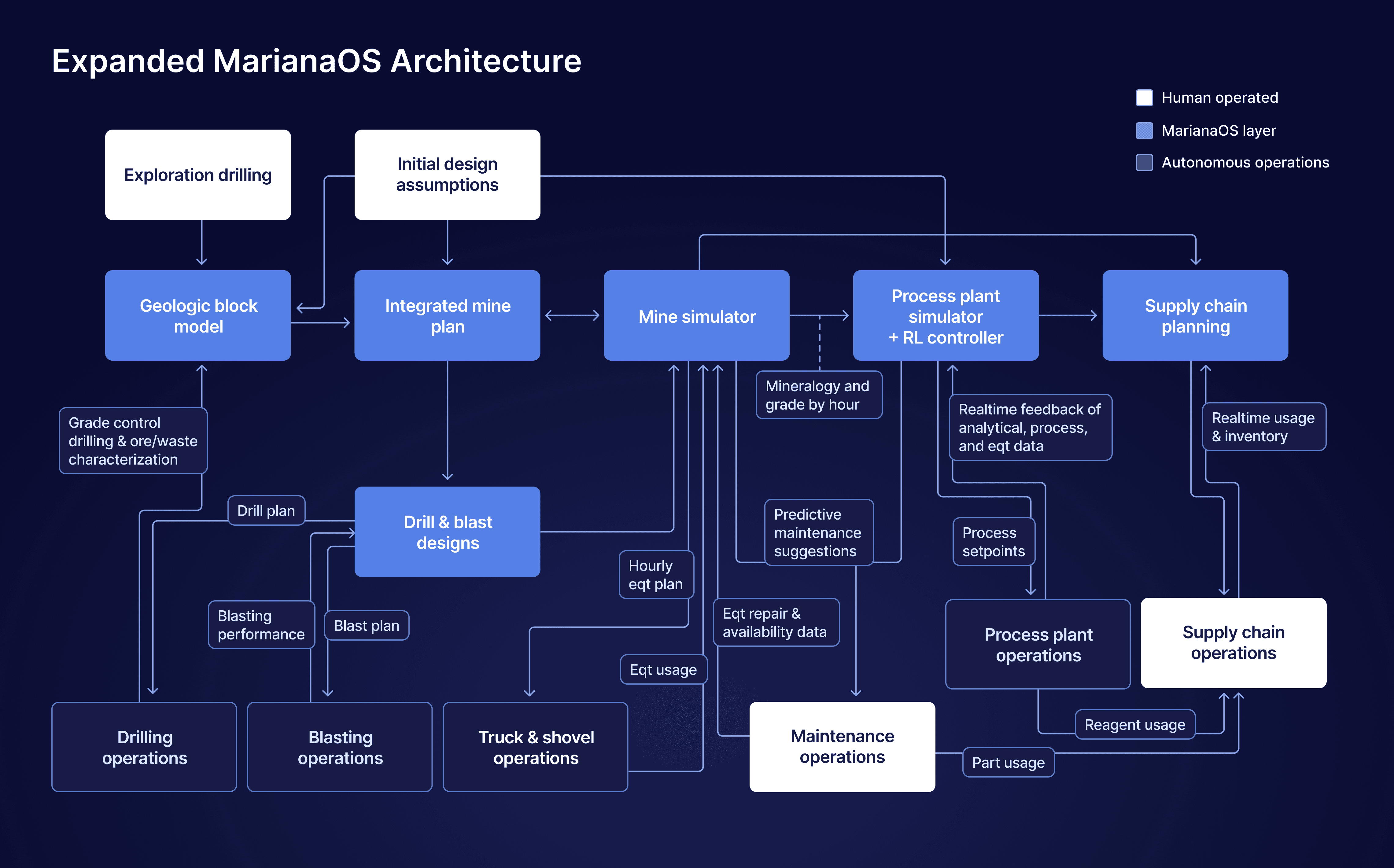
MarianaOS is a unified software platform that connects process development, capital project execution, geologic modeling, mine planning, simulation, fleet orchestration, plant control, maintenance, and supply chain management to automate operational optimization across the value chain. This integration gives operating teams a single, real-time view of distributed systems - from fleet telemetry and process plant performance to market signals and supply chain management. Automated data pipelines ensure information flows reliably and continuously, eliminating manual reporting delays and enabling faster operational responses.
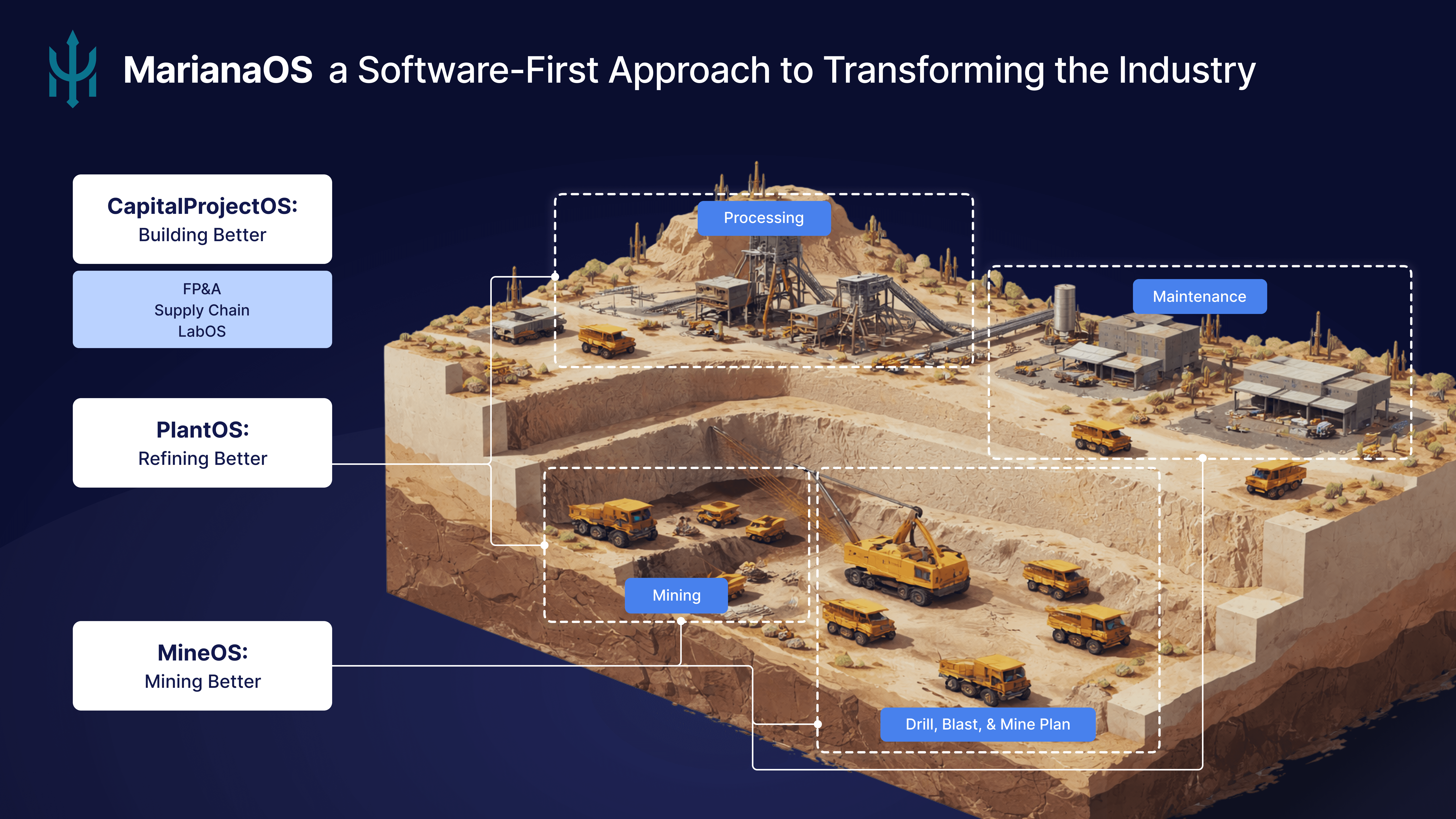
On top of this integrated data layer, machine learning and reinforcement learning optimize complex operational tradeoffs - drill patterns, haulage routing, blending strategies, plant throughput, reagent, and energy use - while continuously learning from outcomes. The result is a self-improving system that autonomously orchestrates decisions across the mine, refinery, and logistics network, increasing productivity and reducing costs.
MarianaOS uses simulation, predictive maintenance, and reinforcement learning to automate drill and blast operations, truck and shovel orchestration, and process plant control based on real-time data; it handles continuous optimization and data integration while engineers, geologists, operators, and planners validate models, monitor the operation, and execute essential, hard to automate tasks. The expertise and creativity of great people remain essential, but autonomy and agentic workflows enable us to mine and refine more while the skilled labor pool shrinks.
The Impact of Autonomy
MarianaOS will significantly improve mining productivity, efficiency, safety, and environmental performance at Copper One. This is increasingly critical as over 200,000 people in the current US mining workforce will retire this decade, while fewer than 400 mining engineering students graduate annually in the US. The data below shows actual results from the Garpenberg Mine in Sweden, which implemented automation and remote control over a 13-year period. The operator realized step-change improvements in productivity, equipment utilization, diesel consumption, and workforce injuries.
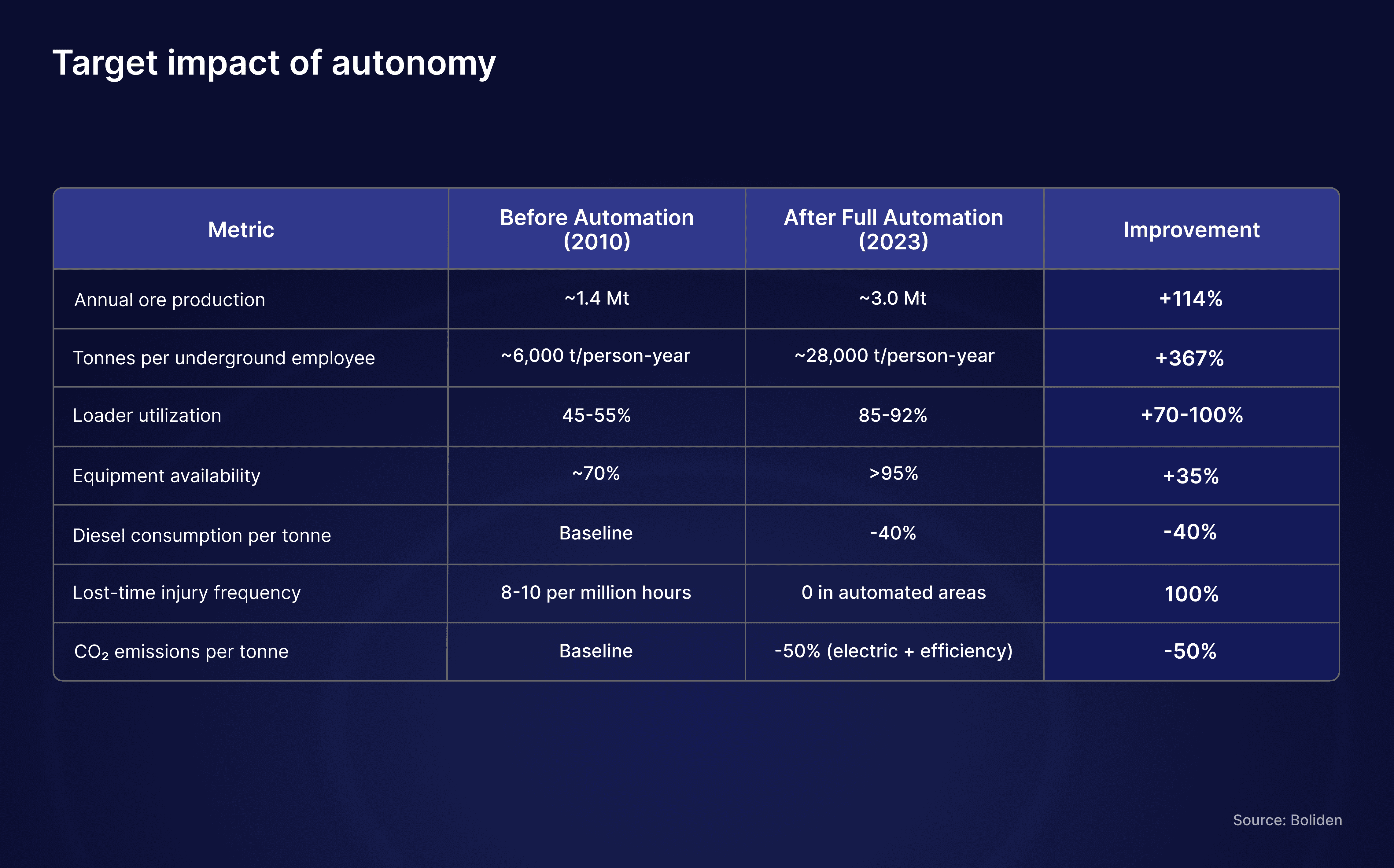
There is a massive amount of meat on the bone in optimizing mining operations, and while some mines globally have introduced remote controlled and semi-autonomous operations (like the example above), full implementation requires custom development with third parties and high latency interfaces between site teams and technology partners, can take over a decade, and still relies heavily on human-in-the-loop control. MineOS compresses this implementation timeline, accelerating the deployment of autonomous mining and support equipment, automating and integrating data pipelines between distributed systems, and driving human-in-the-loop operations to near zero.
Why Recycling Matters
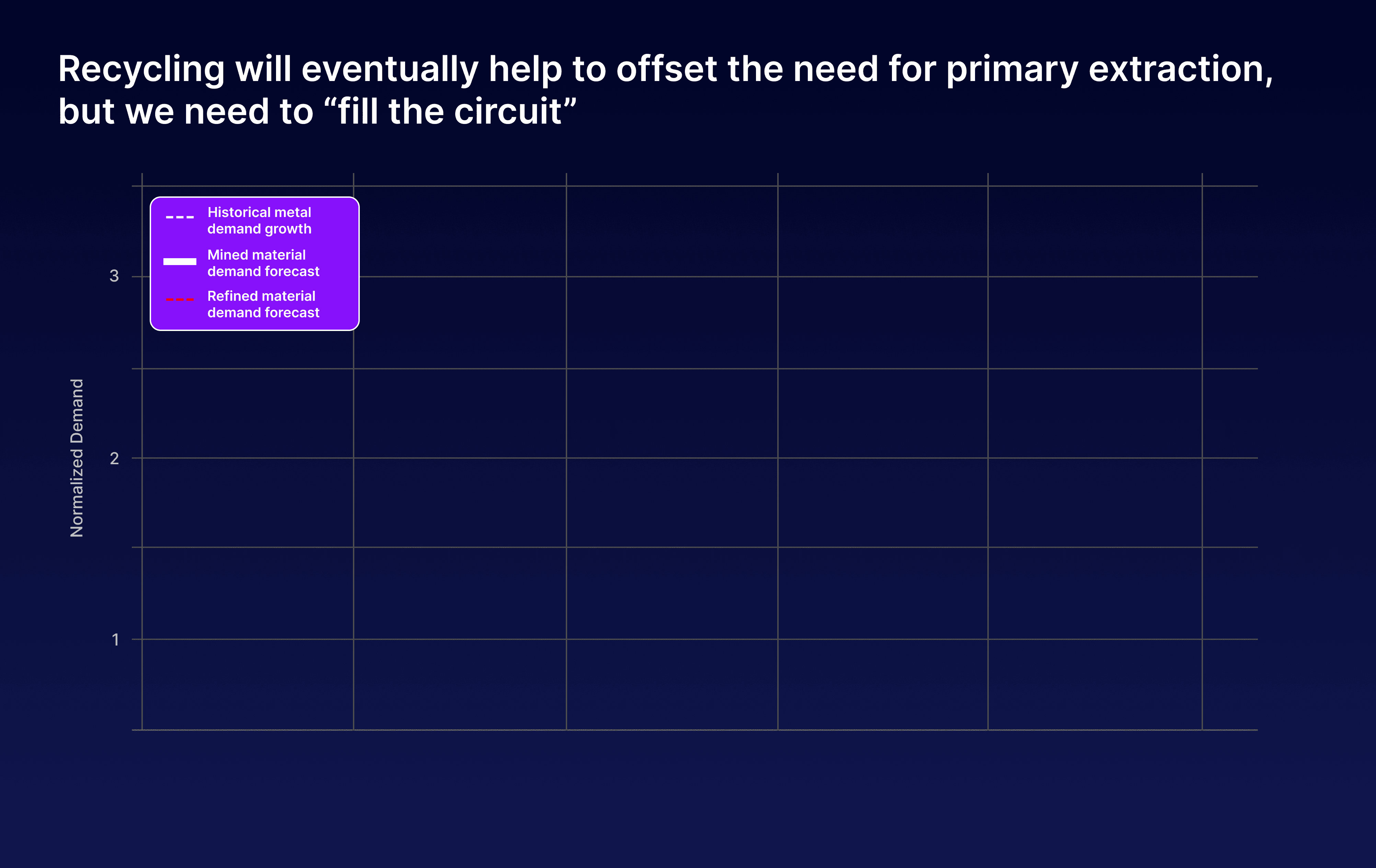
Recycling copper scrap represents a significant opportunity to accelerate U.S. copper supply independence. Copper can be recycled repeatedly without losing its properties, making scrap an important secondary source of supply. Recycling already contributes hundreds of thousands of tons of copper to US supply each year, but a large share of domestically generated scrap is exported rather than processed at home.
The United States exported nearly ~950,000 metric tons of copper scrap in 2024, making it the world's largest copper scrap exporter, with more than 40% going to China. The scrap exported each year, if processed domestically, would meaningfully reduce US reliance on imported copper and strengthen the resilience of the domestic supply chain.
At Copper One, we're integrating copper scrap processing directly into our existing refining circuit. Our solvent extraction-electrowinning system is well-suited to process both primary ore from mining operations and secondary copper from scrap feedstocks. By tooling the refinery to handle both sources, we can put a very real dent in the copper scrap exported from the US annually, capturing domestic secondary resources that would otherwise be shipped overseas for processing and subsequent import.
This dual-feedstock approach aligns with a core thesis at Mariana that we’ve had from the beginning - modern refineries must be designed to process both geologic and recycled feedstocks. As we scale Copper One to 50,000 metric tonnes of refined copper output per year, scrap processing will be a meaningful contributor to our output and a proof point that recycling can be done economically in the United States. Enough excuses. Enough stasis.
We're not just talking, we're taking action.
The past decade has been filled with promises to rebuild US mining capacity - promises that rarely materialize into meaningful production. We need to break out of the pattern of never-ending feasibility studies and multi-billion-dollar first-of-a-kind projects that take decades to build.
Copper One is an operating mine and refinery. We're not starting from scratch. We're deploying MarianaOS at a site that has been producing copper for over 15 years, demonstrating that autonomy can unlock step-change improvements in safety, efficiency, and output.
Our plan at Copper One: deploy autonomous control of heap bioleaching, solvent extraction, and electrowinning to maximize copper recovery; restart mining operations with autonomous orchestration; integrate copper scrap processing to capture domestic secondary resources; and execute a major expansion to ramp output to 50,000 metric tonnes per year.
Mariana's mission is to build the safest, most environmentally responsible, and most efficient minerals operations on earth. Copper One is where we prove that software-first mining can deliver on that promise - at scale. In the coming months, we'll share more on our technology deployment and progress toward autonomous operations.
And the best part – we're just getting started.
Why Recycling Matters
Recycling copper scrap represents a significant opportunity to accelerate US copper supply independence. Copper can be recycled repeatedly without losing its properties, making scrap an important secondary source of supply. Recycling already contributes hundreds of thousands of tons of copper to US supply each year, but a large share of domestically generated scrap is exported rather than processed at home.
The United States exported nearly ~950,000 metric tons of copper scrap in 2024, making it the world's largest copper scrap exporter, with more than 40% going to China. The scrap exported each year, if processed domestically, would meaningfully reduce US reliance on imported copper and strengthen the resilience of the domestic supply chain.
At Copper One, we're integrating copper scrap processing directly into our existing refining circuit. Our solvent extraction-electrowinning system is well-suited to process both primary ore from mining operations and secondary copper from scrap feedstocks. By tooling the refinery to handle both sources, we can put a real dent in the copper scrap exported from the US annually, capturing domestic secondary resources that would otherwise be shipped overseas for processing and subsequent import.
This dual-feedstock approach aligns with a core thesis at Mariana that we’ve had from the beginning - modern refineries must be designed to process both geologic and recycled feedstocks. As we scale Copper One to 50,000 metric tonnes of refined copper output per year, scrap processing will be a meaningful contributor to our output and a proof point that recycling can be done economically in the United States. Enough excuses. Enough stasis.
We're not just talking, we're taking action.
The past decade has been filled with promises to rebuild US mining capacity - promises that rarely materialize into meaningful production. We need to break out of the pattern of never-ending feasibility studies and multi-billion-dollar first-of-a-kind projects that take decades to build.
Copper One is an operating mine and refinery. We're not starting from scratch. We're deploying MarianaOS at a site that has been producing copper for over 15 years, demonstrating that autonomy can unlock step-change improvements in safety, efficiency, and output.
Our plan at Copper One: deploy autonomous control of heap bioleaching, solvent extraction, and electrowinning to maximize copper recovery; restart mining operations with autonomous orchestration; integrate copper scrap processing to capture domestic secondary sources; and execute a major expansion to ramp output to 50,000 metric tonnes per year.
Mariana's mission is to build the safest, most environmentally responsible, and most efficient minerals operations on earth. Copper One is where we prove that software-first mining can deliver on that promise - at scale. In the coming months, we'll share more on our technology deployment and progress toward autonomous operations.
And the best part: we're just getting started.
The issue isn’t isolated to the U.S. Over the past 25 years, major Western copper producers globally have struggled just to maintain output, while Chinese companies have scaled globally to levels that today exceed the combined production capacity of their Western counterparts.
MarianaOS breaks this paradigm.
MarianaOS is a unified software platform that connects process development, capital project execution, geologic modeling, mine planning, simulation, fleet orchestration, plant control, maintenance, and supply chain management to automate operational optimization across the value chain. This integration gives operating teams a single, real-time view of distributed systems - from fleet telemetry and process plant performance to market signals and supply chain management. Automated data pipelines ensure information flows reliably and continuously, eliminating manual reporting delays and enabling faster operational responses.
On top of this integrated data layer, machine learning and reinforcement learning optimize complex operational trade-offs—drill patterns, haulage routing, blending strategies, plant throughput, reagent, and energy use - while continuously learning from outcomes. The result is a self-improving system that autonomously orchestrates decisions across the mine, refinery, and logistics network, increasing productivity and reducing costs.
MarianaOS uses simulation, predictive maintenance, and reinforcement learning to automate drill and blast operations, truck and shovel orchestration, and process plant control based on real-time data; it handles continuous optimization and data integration while engineers, geologists, operators, and planners validate models, monitor the operation, and execute essential, hard to automate tasks. The expertise, judgment, and creativity of great people remain essential, but autonomy and agentic workflows enable us to mine and refine more while the skilled labor pool shrinks.
Ready to Make a Lasting Impact ?
Join Our Team