What are Critical Minerals?
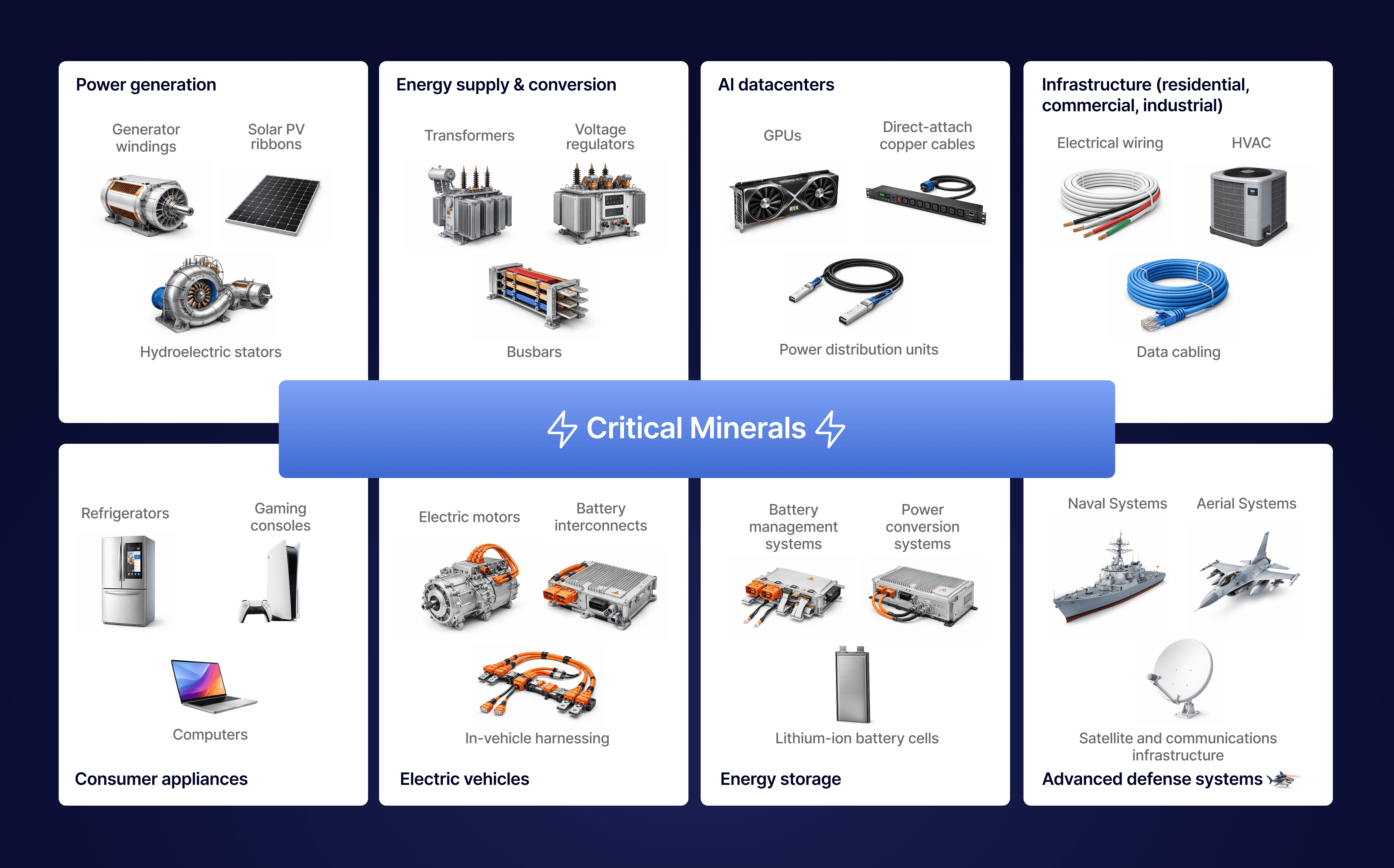
Critical minerals are integral to the modern economy, and are the key inputs to advanced manufacturing, energy storage, electrified transport, electronics, AI infrastructure, aerospace, and defense.
Because these materials are so widely used, disruptions in supply can have far-reaching effects that reduce production, increase costs, and impact multiple sectors at once. As supply chains have become more interconnected globally, understanding where vulnerabilities exist and quickly working toward solutions has become increasingly important.
Critical minerals are integral to the modern economy, and are the key inputs to advanced
manufacturing, energy storage, electrified transport, electronics, AI infrastructure, aerospace, and defense.
Because these materials are so widely used, disruptions in supply can have far-reaching effects that reduce production, increase costs, and impact multiple sectors at once.
As supply chains have become more interconnected globally, understanding where vulnerabilities exist and quickly working toward solutions has become increasingly important.
Critical minerals are integral to the modern economy, and are the key inputs to advanced manufacturing, energy storage, electrified transport, electronics, AI
infrastructure, aerospace, and defense.
Because these materials are so widely used, disruptions in supply can have far-reaching effects that reduce production, increase costs, and impact multiple sectors at once.
As supply chains have become more
interconnected globally, understanding where
vulnerabilities exist and quickly working toward solutions has become increasingly important.
Why Critical Minerals Matter
Critical minerals make up a large share of economic activity – they show up in products, systems, and processes that most people use every day, but never think about. Due to the vast range of applications for which critical minerals are used, problems with supply rarely stay contained. A shortage in one material can slow production, raise costs, and create knock-on effects across multiple industries.
What might look like a small disruption at the top of the funnel can often lead to a much larger negative impact downstream.
Why Critical Minerals Matter
Critical minerals make up a large share of economic activity – they show up in products, systems, and processes that most people use every day, but never think about. Due to the vast range of applications for which critical minerals are used, problems with supply rarely stay contained. A shortage in one material can slow production, raise costs, and create knock-on effects across multiple industries.
What might look like a small disruption at the top of the funnel can often lead to a much larger negative impact downstream.
How Criticality Is Measured
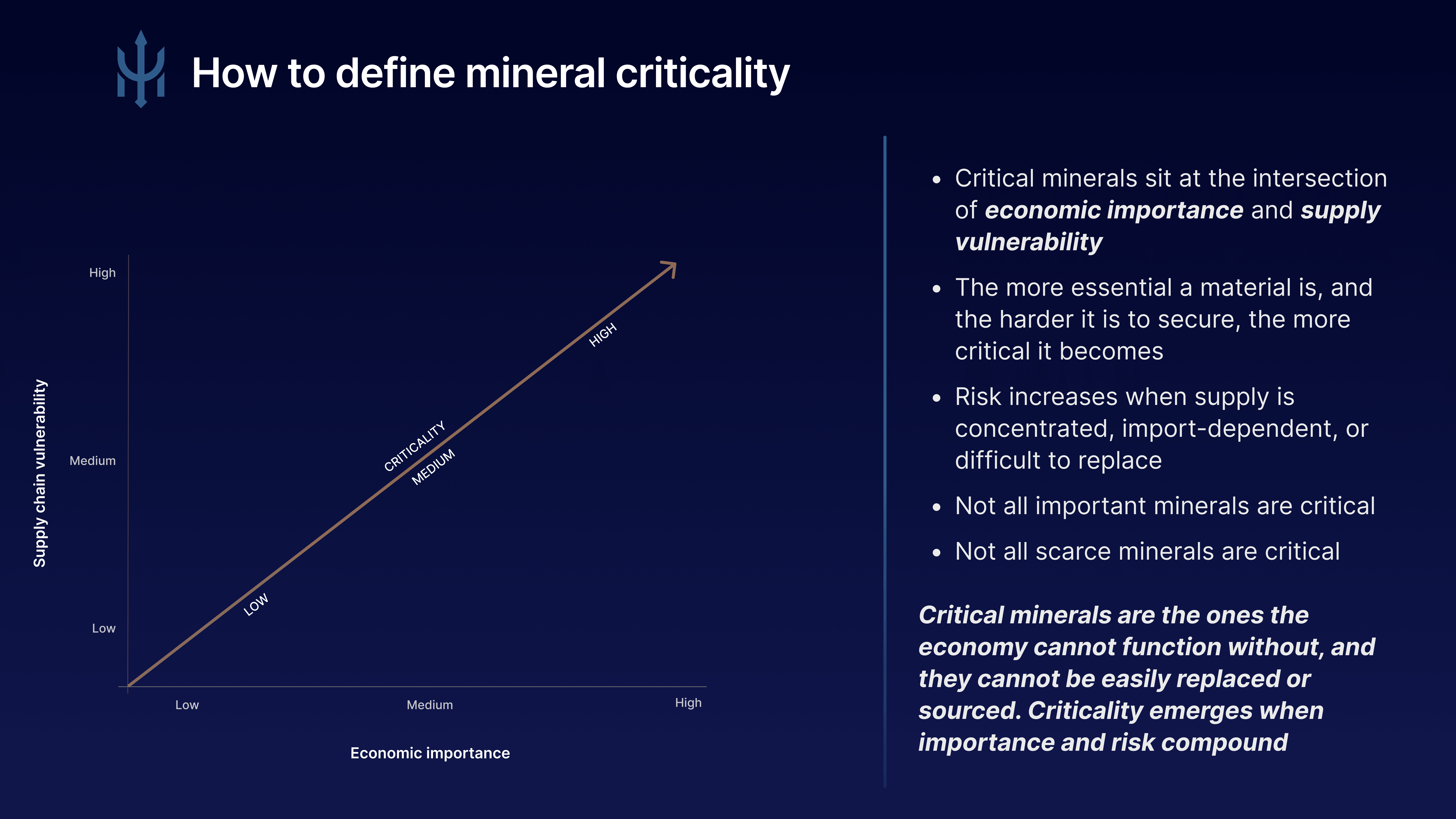
The U.S. Geological Survey (USGS) takes a structured approach to measuring mineral criticality, asking two key questions:
1) How important is the mineral to the economy?
2) How much exposure does the mineral's supply chain have to disruption?
The USGS then goes a step further, modeling what actually happens if supply for a particular mineral or group of minerals is cut. Ultimately, a mineral is considered critical when it scores high on both importance to economy and exposure to supply chain risk - meaning disruptions to production would have real economic consequences.
How Criticality Is Measured
The U.S. Geological Survey (USGS) takes a structured approach to measuring mineral criticality, asking two key questions:
1) How important is the mineral to the economy?
2) How much exposure does the mineral's supply chain have to disruption?
The USGS then goes a step further, modeling what actually happens if supply for a particular mineral or group of minerals is cut. Ultimately, a mineral is considered critical when it scores high on both importance to economy and exposure to supply chain risk - meaning disruptions to production would have real economic consequences.
Why Supply Disruptions Matter
The most important takeaway from the USGS analysis is simple - disruptions to the supply chains of critical minerals have measurable economic consequences. The report models more than a thousand different scenarios where supply from specific countries is cut off. It then tracks how those shockwaves propagate through the U.S. economy. In some cases, the result is a meaningful drop in economic output. Not because the material disappears entirely, but because even partial disruptions can slow down entire chains of production.
The conclusion is clear, impact is not isolated; it spreads. Mineral supply chains are deeply connected to the rest of the economy.
When supply is disrupted, the effects move through manufacturing, processing, and downstream industries. This is why the USGS models the economy as a system. It is not just about one mineral; it is about how everything connects.
Why Supply Disruptions Matter
The most important takeaway from the USGS analysis is simple - disruptions to the supply chains of critical minerals have measurable economic consequences. The report models more than a thousand different scenarios where supply from specific countries is cut off. It then tracks how those shockwaves propagate through the U.S. economy. In some cases, the result is a meaningful drop in economic output. Not because the material disappears entirely, but because even partial disruptions can slow down entire chains of production.
The conclusion is clear, impact is not isolated; it spreads. Mineral supply chains are deeply connected to the rest of the economy.
When supply is disrupted, the effects can move through manufacturing, processing, and downstream industries. This is why the USGS models the economy as a system. It is not just about one mineral; it is about how everything connects.
The Underlying Risk
The associated economic risk is not limited to how much of a mineral exists, it also depends on how the supply is structured. When production is concentrated, substitutes are limited, and domestic capacity is thin, the entire supply chain becomes fragile. In some cases, there is even a single point of failure by which one disruption can wipe out a large portion of supply.
One of the biggest sources of risk in the U.S. is import dependence. For many critical minerals, the U.S. relies on foreign producers for a large share of supply. That dependence is often paired with supply concentration – due to production of certain critical minerals being dominated by just a few countries.
This creates a situation where supply is not only external, but also difficult to replace should something go wrong. Use the tool below to take a more detailed look at U.S. import reliance with respect each critical mineral.
The Underlying Risk
The associated economic risk is not limited to how much of a mineral exists, it also depends on how supply is structured. When production is concentrated, substitutes are limited, and domestic capacity is thin, the entire supply chain becomes fragile. In some cases, there is even a single point of failure by which one disruption can wipe out a large portion of supply.
One of the biggest sources of risk in the U.S. is import dependence. For many critical minerals, the U.S. relies on foreign producers for a large share of supply. That dependence is often paired with supply concentration – due to production of certain critical minerals being dominated by just a few countries.
This creates a situation where supply is not only external, but also difficult to replace should something go wrong. Use the tool below to take a more detailed look at U.S. import reliance with respect to critical minerals.
The Underlying Risk
The associated economic risk is not limited to how much of a mineral exists, it also depends on how the supply is structured. When production is concentrated, substitutes are limited, and domestic capacity is thin, the entire supply chain becomes fragile. In some cases, there is even a single point of failure by which one disruption can wipe out a large portion of supply.
One of the biggest sources of risk in the U.S. is import dependence. For many critical minerals, the U.S. relies on foreign producers for a large share of supply. That dependence is often paired with supply concentration – due to production of certain critical minerals being dominated by just a few countries.
This creates a situation where supply is not only external, but also difficult to replace should something go wrong. Use the tool below to take a more detailed look at U.S. import reliance with respect each critical mineral.
Where Mariana Fits In
Supply chains are becoming more complex and interconnected. As demand grows, the consequences of disruption grow with it. What used to be a manageable constraint can now have economy-wide effects, meaning resilience has shifted from a long-term idea to an immediate priority.
Today, the United States is still heavily dependent on external supply for many critical minerals, creating tangible risk across the economy. At Mariana Minerals, our mission is to change that. Our goal is to strengthen domestic supply chains and build the capacity needed to move from dependence to production - not just to secure supply, but to position the U.S. as a net exporter of critical minerals over time.
If you would like to learn more about critical mineral supply chains and what we're building at Mariana, please contact us at the form below.
Where Mariana Fits In
Supply chains are becoming more complex and
interconnected. As demand grows, the consequences of disruption grow with it. What used to be a manageable constraint can now have economy-wide effects, meaning resilience has shifted from a long-term idea to an immediate priority.
Today, the United States is still heavily dependent on external supply for many critical minerals, creating tangible risk across the economy.
At Mariana Minerals, our mission is to change that. Our goal is to strengthen domestic supply chains and build the capacity needed to move from dependence to production - not just to secure supply, but to position the U.S. as a net exporter of critical minerals over time.
If you would like to learn more about critical mineral supply chains and what we're building at Mariana, please contact us at the form below.